
Coast Guard Auxiliary Leadership (CG-BSX) Policy & Member Resources
Everything on this page is kept in closed sections. Choose a heading to open it, and choose it again to close it.
The Coast Guard Auxiliary (awg-ZIL-yuh-ree) is the uniformed volunteer force of the United States Coast Guard. This office, the Office of Auxiliary and Boating Safety, runs the Auxiliary on the Coast Guard’s behalf and leads the national effort to make recreational boating safer. It is known by the office symbol CG-BSX, and its staff work at Coast Guard Headquarters in Washington, D.C.
The Office of Auxiliary and Boating Safety (CG-BSX) is the United States Coast Guard (USCG) headquarters office responsible for the Coast Guard Auxiliary (awg-ZIL-yuh-ree) and for the National Recreational Boating Safety (RBS) Program. It is located at Coast Guard Headquarters in Washington, D.C.
The office is split in two: the Office of Auxiliary (CG-BSX-1), which is responsible for the Auxiliary itself, and the Office of Boating Safety (CG-BSX-2). Within CG-BSX-1 there are two branches, the Administration Branch (CG-BSX-11) and the Operations Branch (CG-BSX-12).
To Auxiliarists the office is known simply as the Office of the Chief Director of the Auxiliary (CHDIRAUX), and the officer in charge of it holds the title Chief Director of Auxiliary. Several appointed Auxiliary Executive Assistants (EAs) support the Chief Director day to day.
Who holds each post, which Executive Assistant covers which function, and where this office sits in the Coast Guard chain of command are all set out in the Organization section below.
CG-BSX
CG-BSX-1 Logo
- Office symbol
- CG-BSX
- Part of
- United States Coast Guard
- Headquarters
- Washington, D.C.
- Chief Director of Auxiliary
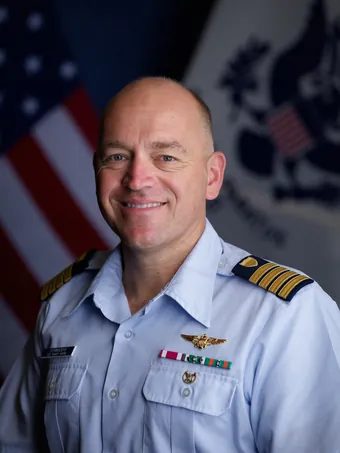
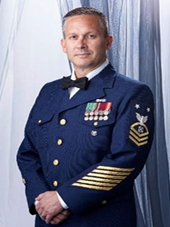
- CAPT Brent R. Schmadeke (SHMAD-uh-kee), USCG
- Deputy Chief Director of Auxiliary
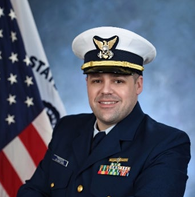
- CDR Peter J. Fransson, USCG
- Administers
- United States Coast Guard Auxiliary, established by Congress in 1939
- CGAUX@uscg.mil



History of the Auxiliary and Its Administration

In 1939 Congress established a United States Coast Guard (USCG) Reserve, administered by the Commandant (KAH-mun-dant) and made up of unpaid volunteer American citizens who owned motorboats or yachts. In 1941 Congress created a military Reserve and renamed the original volunteer body the Coast Guard Auxiliary. The Auxiliary has therefore been administered by the Commandant of the Coast Guard since the day it was created.
Its first statutory purpose, set out in what was then Title 14 of the United States Code, section 822, was to assist the Coast Guard in promoting safety and effecting rescues on and over the high seas and on navigable waters, in promoting efficiency in the operation of motorboats and yachts, in fostering a wider knowledge of and better compliance with the laws governing their operation, and in facilitating other Coast Guard operations. The memorandum that accompanied the Act of 30 September 1944 put it more plainly: the primary purpose was to teach the owners and operators of small craft to operate them safely, and the secondary purpose was to use Auxiliary craft and Auxiliary people, once trained, to carry out certain Coast Guard duties.
The Coast Guard Authorization Act of 1996, signed into law on 19 October 1996, was the first major legislation affecting the Auxiliary since its establishment in 1939. It widened the Auxiliary’s purpose to assisting the Coast Guard, as authorized by the Commandant, in performing any Coast Guard function, power, duty, role, mission or operation authorized by law, and it allowed the Commandant to call on the Auxiliary to assist other Federal agencies, States and local governments in areas beyond recreational boating safety. The same legislation gave the Auxiliary a statutory organizational structure and authorized the Commandant to delegate the management of the Auxiliary to its own elected and appointed leaders.
Where this office comes in: overall authority for administering the Auxiliary rests with the Commandant, under the direction of the Secretary of the Department of Homeland Security (DHS), and the Commandant delegates that authority to Coast Guard offices and officers. The CG-BSX is where that delegated authority sits day to day. Its Chief serves as Chief Director of the Auxiliary, and the office writes the policy the Auxiliary works to, sets the standards Auxiliarists must meet before they are assigned to duties, and speaks for the Auxiliary inside Coast Guard Headquarters.
The office symbol has changed as the Coast Guard has reorganized around it. The office was formerly designated CG-542, and was relabeled as part of the reorganization of the Deputy Commandant for Operations, recorded in All Auxiliary Message (ALAUX) 015 of 2012. The two offices immediately above it were retitled in the same period under ALAUX 019 of 2012: the Assistant Commandant for Marine Safety, Security and Stewardship became the Assistant Commandant for Prevention Policy, and the Director of Prevention Policy became the Director of Inspections and Compliance.
Organization
CG-BSX is led by the Chief Director of Auxiliary.
Office leadership
Surnames link to each person’s biography, in PDF form, on the Chief Director of Auxiliary site.
- Captain (CAPT) Brent R. Schmadeke, USCG — Chief Director of Auxiliary, and Chief, CG-BSX. The Chief Director is the Commandant’s designated representative to the Auxiliary and is responsible for the whole office. He is also the National Coordinator for the National RBS Program. Arrived summer 2024.
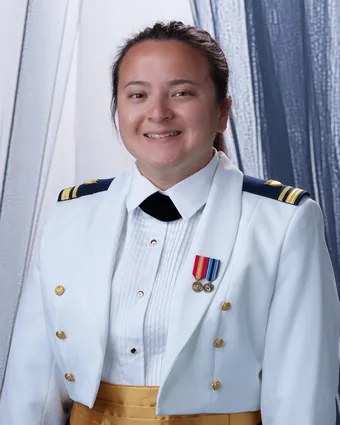
- Commander (CDR) Peter J. Fransson, USCG — Deputy Chief Director of Auxiliary, CG-BSX-1. CG-BSX-1 is the half of the office responsible for the Auxiliary itself, as distinct from CG-BSX-2. Arrived summer 2026. Fransson biography.
Branch chiefs
- Mr. Stephen “Steve” J. Minutolo, USCG CDR (ret.) — Administration Branch Chief (CG-BSX-11). Minutolo biography.
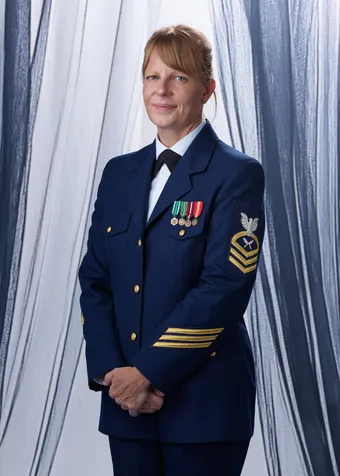
- Master Chief Boatswain’s Mate (BMCM) Jason C. Hermes, USCG — Operations Branch Chief (CG-BSX-12). Arrived summer 2025. Hermes biography.
Administration Branch staff (CG-BSX-11)
The posts below are what the Administration Branch covers: training administration, Auxiliary administration, the security program, and the budget.
- Lieutenant (LT) Kelly M. Richters, USCG — Assistant Administration Branch Chief and Acting Training Manager. Arrived summer 2024. Richters biography.
- Training Program Manager (GS-13) — this post is vacant. LT Richters is covering it in an acting capacity until it is filled.
- Chief Yeoman (YNC) Elina M. Pereira, USCG — Auxiliary Administration Specialist. Arrived summer 2025. Pereira biography.
- Mr. Steven “Steve” R. Keel, USCG CDR (ret.) — Security Program Manager. Keel biography.
- Mr. Randall K. Ellington — Budget and Finance Manager. Ellington biography.
Chief Director of Auxiliary Executive Assistants
Executive Assistants (EAs) are Auxiliarists appointed to support the Chief Director’s Office in a specific subject area. The current EAs and the function each one covers are listed below.
- AUX Jennifer L. Stack — Auxiliary Training Program Administration
- AUX James C. Griffith — Auxiliary Aviation Training Program Administration
- Commodore (COMO) Byron Moe — Auxiliary Aviation Safety
- COMO David A. Elliot — Auxiliary Operations
- AUX Roy Savoca — Auxiliary Surface and Aviation Operations
- AUX Jennifer L. Austin — AUXDATA Operations Support
- COMO Jan R. Munroe — AUXDATA Administration
- AUX Susan Z. Hastings — AUXDATA Administration and Input
- AUX Terry D. Hickox — AUXDATA Database Support
- AUX David E. Gaylord — AUXDATA Support
- COMO Amanda L. Constant — Information Technology Systems Liaison
- AUX John F. Bigrow — Auxiliary Division Website Management
- AUX William J. Sorrentino — Auxiliary Personnel Security Management
- COMO Richard F. Mihalcik — Auxiliary Personnel Security Management
- AUX Thomas M. Stokes — Auxiliary Personnel Security Management
- AUX Salvatore Magro — Auxiliary Personnel Security Management
- COMO Peter Jensen — Auxiliary Personnel Security Management
Position in the Coast Guard Chain of Command
The chain of command above this office runs as follows.
- Secretary of Homeland Security — the Honorable Markwayne Mullin. Sworn in March 2026. The Coast Guard is a military service within the Department of Homeland Security.
- Commandant of the Coast Guard — Admiral (ADM) Kevin E. Lunday, USCG. Arrived winter 2026.
- Deputy Commandant for Operations (CG-DCO) — Vice Admiral (VADM) Nathan A. Moore, USCG. Arrived spring 2026.
- Assistant Commandant for Prevention Policy (CG-5P) — Rear Admiral (RDML) Robert C. Compher, USCG. Arrived summer 2026.
- Director of Inspections and Compliance (CG-5PC) — Captain (CAPT) Daniel H. Cost, USCG. Arrived summer 2026.
- CG-BSX — this office.
Auxiliary Districts
The Coast Guard Auxiliary is divided into districts that sit directly on top of the Coast Guard’s own districts. Where the Coast Guard has one district, the Auxiliary has either one district with the same name or, where the area is large, two or three regions within it. The boundaries are the Coast Guard’s boundaries. The Auxiliary does not draw its own.
In July 2025 the Coast Guard replaced its numbered districts with geographic names, and the Auxiliary followed. No lines were redrawn and no areas of responsibility changed; only the names did. The legacy numbers are still in use alongside the new names, and the AUXDATA codes did not change at all. The authority is ALAUX 029/25 of 30 July 2025, which carried ALCOAST 305/25.
Each district has two leadership structures running side by side. On the Coast Guard side, a Director of Auxiliary (DIRAUX), an active duty Coast Guard officer, is responsible for the Auxiliary in that district: enrollments, security investigations, identification cards, orders, discipline and the issuing of qualifications. An Operations Training Officer (OTO), normally a chief warrant officer, runs operational training and currency. On the Auxiliary side, an elected District Commodore (DCO) leads the volunteers. The Director and the District Commodore work as a pair.
The states and territories listed below are the Coast Guard district boundaries as set out in Title 33 of the Code of Federal Regulations, Part 3. Where a district is split into regions, those regions divide the same territory between them; each district’s own website has the local detail.
Atlantic Area
Five Coast Guard districts, and the Auxiliary districts within them, fall under Coast Guard Atlantic Area.
USCG Northeast District (legacy First District)
Maine, New Hampshire, Vermont, Massachusetts, Rhode Island and Connecticut, with parts of New York and New Jersey. Two Auxiliary regions:
- Northeast District, Northern Region (CGD-NE-NR), AUXDATA code 013. Covers Maine, New Hampshire, Vermont, and Massachusetts. District Commodore Glen A. Gayton. District website.
- Northeast District, Southern Region (CGD-NE-SR), AUXDATA code 014. Covers Connecticut and Rhode Island, plus parts of New York and New Jersey. District Commodore Michael S. Klacik. District website.
USCG East District (legacy Fifth District)
North Carolina, Virginia, the District of Columbia, Maryland and Delaware, with parts of Pennsylvania and New Jersey. Two Auxiliary regions:
- East District, Northern Region (CGD-E-NR), AUXDATA code 053. Covers Delaware, plus parts of Pennsylvania and New Jersey. District Commodore Noreen Schifini. District website.
- East District, Southern Region (CGD-E-SR), AUXDATA code 054. Covers Maryland, Virginia, North Carolina, and the District of Columbia. District Commodore James E. Thomas. District website.
USCG Southeast District (legacy Seventh District)
South Carolina, Georgia and Florida east of a defined line, together with Puerto Rico and the United States Virgin Islands. One Auxiliary district:
- Southeast District (CGD-SE), AUXDATA code 070. District Commodore Martin S. Goodwin. District website.
USCG Heartland District (legacy Eighth District)
The largest district by far. North Dakota, South Dakota, Wyoming, Nebraska, Iowa, Colorado, Kansas, Missouri, Kentucky, West Virginia, Tennessee, Arkansas, Oklahoma, New Mexico, Texas, Louisiana, Mississippi and Alabama, with parts of Pennsylvania, Ohio, Indiana, Illinois, Wisconsin, Minnesota, Florida and Georgia. Three Auxiliary regions:
- Heartland District, Coastal Region (CGD-H-CR), AUXDATA code 081. Covers New Mexico and Texas, plus parts of Georgia, Florida, Alabama, Mississippi, Louisiana, and Oklahoma. District Commodore Douglas R. Ritchie. District website.
- Heartland District, Eastern Region (CGD-H-ER), AUXDATA code 082. Covers Kentucky and West Virginia, plus parts of Indiana, Ohio, Pennsylvania, Tennessee, Missouri, Alabama, and Mississippi. District Commodore Ronald R. Boneau. District website.
- Heartland District, Western Rivers (CGD-H-WR), AUXDATA code 085. Covers Wyoming, Colorado, North Dakota, South Dakota, Kansas, Nebraska, Arkansas, and Iowa, plus parts of Minnesota, Wisconsin, Illinois, Missouri, Tennessee, Oklahoma, Louisiana, and Mississippi. District Commodore Robert R. Arisman. District website.
USCG Great Lakes District (legacy Ninth District)
Michigan, with parts of New York, Pennsylvania, Ohio, Indiana, Illinois, Wisconsin and Minnesota. Three Auxiliary regions:
- Great Lakes District, Central Region (CGD-GL-CR), AUXDATA code 091. Covers parts of Ohio, the eastern and northern parts of Michigan, and the northern parts of Wisconsin and Minnesota. District Commodore Mark R. Villeneuve. District website.
- Great Lakes District, Eastern Region (CGD-GL-ER), AUXDATA code 092. Covers parts of New York, Pennsylvania, and Ohio along Lake Erie. District Commodore Steven R. Botsford. District website.
- Great Lakes District, Western Region (CGD-GL-WR), AUXDATA code 095. Covers parts of Indiana and Illinois, the Lake Michigan side of Wisconsin, and western Michigan. District Commodore Robert E. Kumpf. District website.
Pacific Area
Four Coast Guard districts, and the Auxiliary districts within them, fall under Coast Guard Pacific Area.
USCG Southwest District (legacy Eleventh District)
Arizona, Utah, Nevada and California. Two Auxiliary regions:
- Southwest District, Northern Region (CGD-SW-NR), AUXDATA code 113. Covers northern and central California, plus northern Nevada and northern Utah. District Commodore James G. Losi. District website.
- Southwest District, Southern Region (CGD-SW-SR), AUXDATA code 114. Covers Arizona and southern California, plus southern Nevada (the Las Vegas area) and southern Utah (the St. George area). District Commodore Rodney L. Donohoo. District website.
USCG Northwest District (legacy Thirteenth District)
Washington, Oregon, Idaho and Montana. One Auxiliary district:
- Northwest District (CGD-NW), AUXDATA code 130. District Commodore Klaas Nijhuis. District website.
USCG Oceania District (legacy Fourteenth District)
Hawaii, Guam, American Samoa, and the Commonwealth of the Northern Mariana Islands, along with other United States islands in the Pacific. One Auxiliary district:
- Oceania District (CGD-O), AUXDATA code 140. District Commodore Jodie M. Nelson. District website.
USCG Arctic District (legacy Seventeenth District)
Alaska. One Auxiliary district:
- Arctic District (CGD-A), AUXDATA code 170. District Commodore Chester L. Williams. District website.
Finding your own district
If you are not sure which district you are in, the Flotilla Finder takes a zip code and returns the nearest flotillas with their district. The District Commodores named above are drawn live from AUXDATA through the national unit staff listings, so they follow each district’s elections. The serving Director of Auxiliary and Operations Training Officer for a district are on that district’s own website, linked above.
Directors of Auxiliary
Every Auxiliary district is supported by a Director of Auxiliary, usually called the DIRAUX. The DIRAUX is an active duty Coast Guard officer who manages the Auxiliary in that district: enrollment, discipline, orders, finances and the issuing of certifications. The Operations Training Officer, or OTO, works alongside the Director and handles operational qualification and currency.
The list below is current as of August 2026. Members should contact their own district office. Phone numbers and email addresses are not published here because they change often; your flotilla or division leadership holds the current contact details, and the national office is listed at the end.
Pacific Area
Northwest
Director: CDR Logan Huffman. Operations Training Officer: BOSN Chad Lynch.
915 2nd Avenue, Seattle, WA 98174-1067.
Southwest, Northern Region
Director: CDR Christina Jones. Operations Training Officer: BOSN Mickey Price.
Coast Guard Island, Building 50-2, Alameda, CA 94501-5100.
Southwest, Southern Region
Director: CDR Christina Jones. Operations Training Officer: BOSN Jacob Gore.
1001 South Seaside Avenue, Building 40, Terminal Island, San Pedro, CA 90731-7391.
Arctic
Director: LCDR Nicholas Capuzzi. Operations Training Officer: BMC Sean Towney.
P.O. Box 25517, Juneau, AK 99802-5517.
Oceania
Director: LCDR Christopher Fisher. Operations Training Officer: BOSN Thomas Perez.
300 Ala Moana Boulevard, Honolulu, HI 96850-4982.
Atlantic Area
Northeast, Northern Region
Director: CDR Tyler Kelley. Operations Training Officer: BOSN Timothy Crochet.
408 Atlantic Avenue, Boston, MA 02110-3350.
Northeast, Southern Region
Director: CDR Joshua Buck. Operations Training Officer: BOSN Jason Grimm.
1 South Street, Battery Park Building, Room 210, New York, NY 10004.
East, Northern Region
Director: CDR Ryan Popiel. Operations Training Officer: BOSN Timothy Edwards.
One Washington Avenue, Philadelphia, PA 19147-4395.
East, Southern Region
Director: CDR David Otani. Operations Training Officer: BOSN Breana Born.
431 Crawford Street, Portsmouth, VA 23704-5504.
Southeast
Director: LCDR Benjamin Tuxhorn. Operations Training Officer: BOSN Brook Blount.
Brickell Plaza Federal Building, 909 SE 1st Avenue, Suite 446, Miami, FL 33131-3050.
Great Lakes, Western, Central and Eastern Regions
Director: LCDR Jilian Hoffman. Operations Training Officer: BOSN Richard Hasenstab.
1240 E 9th Street, Cleveland, OH 44199-2060.
Heartland, Western Rivers
Director: LT RikkiLynn Mullen. Operations Training Officer: BOSN Daniel Garver.
1222 Spruce Street, Room 2.102H, St. Louis, MO 63103-2854.
Heartland, Eastern Region
Director: LT RikkiLynn Mullen. Operations Training Officer: BOSN Michael Firth.
1222 Spruce Street, Room 2.102H, St. Louis, MO 63103-2854.
Heartland, Coastal Region
Director: LCDR Nicholas Hartmann. Operations Training Officer: BOSN Jonathan Kwedar.
Hale Boggs Federal Building, 500 Poydras Street, New Orleans, LA 70130-3396.
National
Office of Auxiliary and Boating Safety
CG-BSX: CAPT Brent Schmadeke. CG-BSX-1: CDR Peter Fransson.
2703 Martin Luther King Jr. Avenue SE, Stop 7501, Washington, DC 20593-7501.
Auxiliary National Supply Center
Randy Ernst.
1301 W First Street, Suite E, Granite City, IL 62040-1803.
Coast Guard Auxiliary Association, Incorporated
Heather Naujokas and Michelle LeMay.
1301 W First Street, Suite E1, Granite City, IL 62040-1802.
Duties of the Chief Director’s Office
The following non-inclusive list provides a general description of some of the duties that the Chief Director’s Office is tasked with:
- Direct Auxiliary administration within policies established by the Commandant under authority of 14 U.S.C. § 3901, et seq. (Coast Guard Auxiliary).
- Serve as the Commandant’s designated representative to the Auxiliary National Executive Committee (NEXCOM) and Auxiliary National Board.
- In consultation with the Auxiliary National Commodore (NACO), NEXCOM, and the National Board, as necessary, develop and implement policies and procedures that define standards for the development and organization of Auxiliary personnel and programs.
- Develop policies and procedures to define standards that apply in accepting Auxiliary facilities for Coast Guard use and in training to qualify Auxiliarists before assignment to duties.
- Consult and coordinate with Coast Guard program managers to determine requirements for use of Auxiliary resources within the purposes described in 14 U.S.C. § 3901.
- In consultation with the NEXCOM, develop plans and procedures to achieve and maintain Auxiliary strength characteristics consistent with identified Coast Guard requirements.
- Coordinate requests for and monitor program, facility, and support manager use of Auxiliary personnel and facilities.
- Provide policy and guidance to operational and support commanders on the use and support of Auxiliary personnel and facilities as applied both domestically and internationally.
- Delegate to Auxiliary elected and appointed leaders such matters necessary or appropriate for Auxiliary functioning, organization, and internal administration.
- On behalf of the Commandant, review, approve or disapprove, and implement recommendations of the National Board that affect official publications, the standing rules and bylaws, awards, elements of elected and appointed office, and internal matters of the Auxiliary.
- Actively promote Auxiliary interests.
- Establish and monitor appropriate operational proficiency standards for Auxiliary personnel, facilities, and resources.
- Maintain liaison with appropriate Coast Guard program managers to assist in development and maintenance of Auxiliary policies and training.
- Maintain oversight of and participate in developing and maintaining long-range Commandant (CG-BSX-1) strategic plans.
- Develop appropriate measures of effectiveness and analyze relevant data and alternatives required to support budgetary and policy decisions necessary to ensure adequate levels of Auxiliary support.
- Serve as the planning element for all Auxiliary personnel, facility, and resource related issues.
- Develop, review, and evaluate all national and service-wide plans, policies, procedures, standards, resource, and training requirements necessary for Auxiliary administration and performance.
- Coordinate requests for, and monitor, program, facility, and support manager use of Auxiliary personnel and facilities.
- Maintain oversight of Auxiliary international engagement.
- Prepare, review, and deliver briefings and replies to queries regarding Auxiliary programs such as: briefings and Q&As as requested by Congressional staffs, DHS, and other agencies; Background Book Documents; Questions for the Record; replies to Congressional Inquiries, letters to the President, letters to the Secretary of DHS, CCG; data calls; talking points; myriad queries from Coast Guard and field units.
- Serve as a member of the AUXDATA Change Advisory Board (CAB) and AUXDATA Modernization Project.
- Engage in organizational issues and serve as principal point of contact (POC) for Coast Guard strategic transformation matters.
Additional Duties
The Chief Director’s Office provides administrative, management, and program resource support to enable the Coast Guard Auxiliary to efficiently carry out its assigned missions and authorized activities. It collaborates with other Coast Guard Headquarters program managers, National Auxiliary leadership, and regional Director of Auxiliary (DIRAUX) offices to enable the Coast Guard’s volunteers to:
- Promote and improve RBS
- Provide a diverse array of specialized skills, trained crews, and capable facilities to augment the Coast Guard and enhance safety and security of our ports, waterways, and coastal regions
- Support Coast Guard operational, administrative, and logistical requirements.
The Chief Director’s Office is the Auxiliary’s primary Headquarters advocate and champions the Auxiliary’s ability to support:
- U.S. Coast Guard Auxiliary Policy Statement
- National RBS Program Strategic Plan
- U.S. Coast Guard Auxiliary Strategic Plan
- U.S. Coast Guard Assistant Commandant for Prevention Policy Strategic Plan
Plan names above link to the current published document, in PDF form.
In striving to support these plans, the Chief Director’s Office tries to adhere to the following principles as a framework for its strategic objectives:
- Administrative and program management processes should be streamlined so Auxiliarists focus on support of the Auxiliary Strategic Plan, experience greater satisfaction from direct engagement with the Coast Guard through authorized Auxiliary activities, and convey greater support of the National RBS Program Strategic Plan.
- Opportunities should be identified for major programmatic cost avoidances and savings so that the limited program resource base can be reinvested toward tools and programs that benefit a broader range of Auxiliarists.
- Opportunities should be identified for the reduction of Auxiliarists’ out-of-pocket expenses so their limited personal resources can be focused on meaningful and distinct tools needed for Auxiliary membership.
- Opportunities that promote organizational growth and provide greater opportunities to attract citizens from all segments of society should also be identified, considered, and acted upon with a bias toward creating a more viable Auxiliary workforce that reflects the American public.
The Chief Director’s Office provides direct administrative and programmatic support to:
- Regional DIRAUXs and their staffs
- Other Coast Guard Headquarters staff elements and program managers
- National Executive Committee (NEXCOM)
- Assistant National Commodores, Directorate Chiefs, and their staffs
Through its provision of such support to these customers, Chief Director’s Office also indirectly serves and collaborates with:
- The maritime public, particularly America’s recreational boaters
- Other federal, state, and municipal maritime agencies
- Commercial and private organizations that share maritime interests
While the Coast Guard receives a remarkable return on its Auxiliary investment, the Auxiliary program is not immune from budgetary/human resource reductions.
The Auxiliary’s ability to contribute to the Coast Guard’s missions is virtually limitless. Conversely, the ability of the Coast Guard to appropriately leverage the time, treasures, and talents of its volunteer workforce is limited by its capacity to effectively administer and manage its programs. A constructive balance should be maintained between Auxiliary self-administration and direct Coast Guard oversight. The Chief Directors Office should remain flexible and responsive to the ever-changing needs and expectations of the chain of command, chain of leadership, and needs of the Service. Chief Directors Office should remain most sensitive to:
- Safety and Security: Any programmatic deficiency that places any number of Auxiliarists at personal risk (operationally, privacy, health and well-being, etc.)
- Emergent needs of the Coast Guard, as directed by the Commandant and CHDIRAUX
- Emergent needs of DIRAUXs
- Headquarters program managers
- Auxiliary policies, instructions, and guidance that have universal applicability to the entire Auxiliary organization
- Unique “niche” programs that provide new or different levels of support to the Coast Guard
Points of Contact (POC)
Who to write to depends on what the question is. Working through the right contact first is faster than writing here, and in most cases it is required.
If you are an Auxiliarist
Raise the question with your Chain of Leadership and Management first, including your District DIRAUX. Most questions are answered there. Write to this office only after you have done that, or if your DIRAUX or this office has directed you to.
If you are a member of the public
Use the website listed under Quick Links that matches what you need. This office cannot answer general Coast Guard inquiries. The Frequently Asked Questions section near the bottom of this page answers the questions this office is asked most often, and links to the right site for each one.
If you are a member of the media
Contact the Coast Guard public affairs office nearest to you. Media queries are handled by the public affairs office covering the area the story concerns, not by this office.
If you are reporting a navigation marker or buoy out of position
Call your local non-emergency law enforcement number. They will pass it to the nearest Coast Guard unit. If it is an immediate danger to life, call 911 or hail the Coast Guard on VHF channel 16.
Office mailbox
This mailbox is monitored during normal business hours, Monday through Friday. Replies take two to three business days on average. It is for programmatic questions about the Coast Guard Auxiliary, not for general Coast Guard questions.
Mailing address
Commandant (CG-BSX)
U.S. Coast Guard Headquarters
2703 Martin Luther King Jr. Avenue SE, Stop 7501
Washington, DC 20593
Frequently Asked Questions (FAQ)
What is the Coast Guard Auxiliary?
The Coast Guard Auxiliary is the uniformed volunteer component of the United States Coast Guard. Congress established it in 1939 as a volunteer Reserve of citizens who owned motorboats or yachts, and renamed it the Coast Guard Auxiliary in 1941. There is more on this in the History section above.
Is the Auxiliary part of the military?
No. The Auxiliary is non-military. Auxiliarists are civilian volunteers who support Coast Guard missions. They do not carry military or law enforcement authority.
Who can join?
Membership is open to any citizen of the United States, its territories and its possessions who is seventeen years of age or older. There is no maximum age. People who hold dual citizenship may join, although a second citizenship in certain countries limits the more advanced security investigations later on. Members of the armed forces on active duty or in a Reserve component may join, as may veterans discharged under honorable conditions.
There are no physical standards for joining, and no medical examination is required to enroll. Physical ability matters only for particular operational qualifications, such as boat crew, where a member has to be able to carry out the tasks safely.
Some things do rule an applicant out. You must have a Social Security number. You cannot join while a criminal case against you is open, while you are on parole or probation or otherwise under criminal restraint, or if you have been convicted of a felony or a major misdemeanor, a domestic violence charge, or are a current or former registered sex offender. Prior military service recorded on a DD-214 with a reenlistment code of RE-4 is also disqualifying, though in limited circumstances a waiver may be considered. The full list is on the Auxiliary’s membership eligibility page.
How do I join, and what is the process?
The steps are these.
- Contact a flotilla. Use the Flotilla Finder to reach a unit near you, or send your details through the Auxiliary recruiting site and a local unit will contact you. You may join any flotilla you choose, wherever you live.
- Visit and talk to the unit. Flotillas welcome visitors at their meetings. This is where you find out what the unit does and the unit finds out what you are interested in.
- Complete the enrollment application. It is filled in online. The paperwork for the security investigation is built into it, so there is no separate form to chase. You also become a member of the Coast Guard Auxiliary Association, Inc., which is part of enrollment.
- Give fingerprints. Fingerprint cards are the one part of the security paperwork that is not in the online application.
- Pass the New Member Exam. It is an open-book exam on the basics of the Auxiliary.
- The Director of Auxiliary signs your application. You are then entered in AUXDATA in Approval Pending status. From that point you are a member and may take part in most Auxiliary activity, with some restrictions until the background check is finished.
- The background check is completed. Every new member undergoes a Personnel Security Investigation. The entry level investigation is called Operational Support, and it covers most activity. Two higher levels exist for members who later need access to Coast Guard computer networks or who take on security-sensitive operational roles. When the Coast Guard Security Center returns a favorable result, the Director moves you into full membership status.
- Take the pledge. New members are administered the Pledge for New Members at a flotilla meeting or another suitable event.
The background check is routine and it is required because Auxiliarists are trusted with sensitive work on behalf of the Coast Guard. It is the step that takes the longest.
Do I need a boat to join?
No. Owning a boat, an aircraft or a radio station is useful to the Auxiliary but it is not a requirement, and neither is any particular skill or trade. Most Auxiliarists do not own a boat.
The work covers far more than being on the water. Auxiliarists teach boating safety courses, carry out free vessel safety checks, visit marine dealers under the Recreational Boating Safety Visitation Program, stand radio watches, verify aids to navigation, work in Coast Guard command centers and administrative offices, support marine safety and environmental response, serve as interpreters, cooks, health care providers and religious ministry support at Coast Guard units, handle information technology and public affairs, run unit finances and records, work in emergency management, and mentor young people. If you have a skill, the Auxiliary almost certainly has a use for it.
Do I have to wear a uniform?
No member is required to buy or wear a uniform in order to belong to the Auxiliary. The uniform is required only for particular activities, chiefly crewing a boat or aircraft on an ordered patrol, carrying out vessel safety checks, teaching a public education class, a first visit under the Recreational Boating Safety Visitation Program, and duty assigned at a Coast Guard unit. A member who does not do those things can take a full part in Auxiliary life in ordinary clothes, and the Auxiliary name tag may be worn on civilian clothes when serving in an Auxiliary capacity.
Where a uniform would normally be worn, the Auxiliary Blue Blazer outfit is an authorized alternative to the service uniform, and after the first visit under the Visitation Program civilian clothes are authorized.
Can I join if I am on active duty, in the Reserve, or a veteran?
Yes. Membership is open to United States citizens serving on active duty or in a Reserve component, and to veterans of those services discharged under honorable conditions. Serving members join as Auxiliarists in their own right; Auxiliary service is separate from military duty and does not replace it.
Anyone under seventeen cannot enroll, whatever their standing elsewhere. Sea Cadets and other youth members should look at the youth question above. A cadet or officer candidate who is already a member of a service and is seventeen or over falls under the rule above; if your situation is not clearly covered, your District Director of Auxiliary decides it.
If I served in the Coast Guard, do my qualifications carry over?
Many of them do. A member of the Coast Guard who separates or retires under honorable conditions and then joins the Auxiliary may be credited with Auxiliary qualifications for what they already hold. The credit covers any three-year period between the last time the qualification was current and the date of Auxiliary enrollment. So a boatswain’s mate whose coxswain currency lapsed two years before separation has one year after separation to enroll and still be credited.
The District Director of Auxiliary grants the credit and may also waive the approved boating safety course and most Auxiliary Core Training for this purpose. The BQII course cannot be waived. Once BQII is done, the Director can place the new member straight into Basically Qualified status.
These are the conveyances currently authorized. The Coast Guard qualification or rating comes first, and what it may be granted in the Auxiliary follows.
- Aircraft Commander, with a current FAA third class medical or higher, an FAA airman certificate at private pilot or above, and a current biennial flight review — Aircraft Commander, First Pilot and Co-Pilot, fixed wing or rotary wing as appropriate, and Air Observer.
- First Pilot, with the same FAA requirements — First Pilot and Co-Pilot, fixed or rotary wing as appropriate, and Air Observer.
- Co-Pilot, with the same FAA requirements — Co-Pilot, fixed or rotary wing as appropriate, and Air Observer.
- Aviation Maintenance Technician, Aviation Survival Technician or Avionics Electrical Technician, any rank — Air Crewman and Air Observer.
- Chaplain — Chaplain.
- Coxswain of any Coast Guard standard small boat, not counting cutter standard small boats — Coxswain, Personal Watercraft Operator and AUXOP.
- Coxswain of any Coast Guard cutter standard small boat — Coxswain and Personal Watercraft Operator. The Navigation Rules examination must be passed first unless a current Deck Watch Officer examination is already on record.
- Crewmember of any Coast Guard standard small boat, cutter small boats included — Crewmember.
- Culinary Specialist, any rank — Culinary Assistant (AUXCA-1).
- Deck Watch Officer — AUXOP.
- Full-time instructor at any Coast Guard training center, or a current Coast Guard Team Coordination Training facilitator — Instructor.
- Maritime Law Enforcement Specialist, any rank, or Maritime Law Enforcement Boarding Officer — Vessel Examiner, Program Visitor and Commercial Fishing Vessel Safety Examiner.
- Musician — Musician at the level matching the Coast Guard rank, so a Coast Guard MU3 is granted AUXMU-3.
- Operations Specialist of any rank, Command Center Duty Officer, Boat Forces Unit Officer of the Day, or Communications Watchstander — Communications Watchstander.
- Public Affairs Specialist — Public Affairs Specialist at the level matching the Coast Guard rank, so a Coast Guard PA3 is granted AUXPA-3.
The list is not closed. CG-BSX-1 reviews further Coast Guard qualifications and ratings for conveyance as the need arises. The authority is ALAUX 015/23, as amended by ALAUX 038/23.
I am a lawyer, doctor, chaplain, or another specialized professional. How do I join and put my skills to use?
You join exactly the way everyone else does. There is no separate professional entry, no commission and no direct appointment. You enroll in a flotilla, meet the same requirements as any other applicant, and then qualify into whichever program matches what you do. The question of how to join is answered above; this answer is about what comes after.
What follows are the programs that exist today. A professional credential is what makes you eligible for one of them. It is not a qualification by itself, and in most cases there is a background investigation beyond the ordinary enrollment check.
Medicine and dentistry. Physicians, dentists, physician assistants, nurse practitioners and pharmacists may volunteer in Coast Guard clinics, in places where the Coast Guard already provides that level of care, under the Medical Manual, COMDTINST M6010.2 (series). Registered nurses, emergency medical technicians, paramedics and other first responders are covered separately and may volunteer in Coast Guard health care facilities under COMDTINST M6000.1 (series). The work is support to Coast Guard health care; it is not a route to treating the public under Auxiliary auspices.
Clergy. The Auxiliary Chaplain Support program lets qualified clergy supplement Coast Guard chaplains. Approved members are called ACS Chaplains, and the program is clear that they support Coast Guard chaplains rather than replace them. The requirements are substantial and worth knowing before you start. You need the same education and ecclesiastical endorsement that a Department of Defense chaplain holds, and the endorsement must be national, not from a local church or a regional conference. You provide transcripts for each degree. You complete a personnel security investigation with a favorable determination and a child care check. The package needs a letter from a Coast Guard commanding officer confirming your suitability and a recommendation from a supervisory Coast Guard chaplain, and the final decision belongs to the Chaplain of the Coast Guard. There is a provisional period with required training before the qualification is complete.
Law. The Auxiliary appoints its own legal officers. Each district has a District Legal Officer, each Area has an Assistant Chief Counsel, and the Chief Counsel advises the National Commodore, the Chief Director and the National Executive Committee. These officers advise the Auxiliary on its own affairs. Two points should be stated plainly. This is not practicing law on behalf of the Coast Guard, and it does not make anyone a Coast Guard judge advocate. An attorney who wants to serve the Coast Guard as a judge advocate applies to the Coast Guard directly through its own commissioning programs, not through the Auxiliary.
Languages. The Auxiliary Interpreter Corps supports operational, administrative and public affairs missions. Interpreters work under Coast Guard orders, and the requesting unit is the authority that assigns them to duty.
Other skills that have a home here. Pilots and aircrew serve in the aviation program, where a pilot must hold the required Federal Aviation Administration certificates. Culinary professionals serve Coast Guard units through the food services program after completing its training. There are also established roles for writers, photographers, public affairs specialists, web developers, radio operators, instructors, and members who serve as ombudsmen for Coast Guard families.
Two things are worth knowing before you apply. A license or an ordination does not transfer on its own: every one of these programs has its own qualification process, and some take months. And the Auxiliary cannot create a role that does not exist. If your profession is not on this list, the honest answer is that there may be no program for it yet, though many members find that the skills behind the profession, rather than the profession itself, are what the Auxiliary ends up using.
Start with the flotilla nearest you, which you can find through join.cgaux.org, and tell them what you do. For the programs that need Coast Guard approval, such as chaplain support and health services, your District Director of Auxiliary office is the one that carries the package forward.
How can young people get involved?
Seventeen is the minimum age to enroll as an Auxiliarist, and members join at every age from seventeen upward. There are also two established routes for younger people and for students.
Sea Scouts. The Auxiliary runs a youth development program with Sea Scouts, the oldest older-youth program of Scouting America, which enrolls young people aged fourteen to twenty-one, or thirteen if they have completed the eighth grade. Auxiliarists support Sea Scout units with boating safety instruction, boating skills, science and engineering training and maritime heritage. The program is set out in AUX-SOP-002(F).
The Auxiliary University Program. Students at an accredited American college or university can join the Auxiliary and then apply to the Auxiliary University Program, which has run since 2007 and operates units representing more than fifty colleges and universities. Students work through a program of study in boating education, homeland security and operational leadership, and can go on to an active duty Coast Guard internship. The program has a strong record of placing graduates into Coast Guard Officer Candidate School, and a graduate who chooses to enlist instead is promotable to pay grade E-3 on completing basic training.
How do I get a new Auxiliary identification card?
Through your District Director of Auxiliary. The Director issues every Auxiliary identification card and signs it, and the Director is the only person who can issue a replacement. Your first card is issued once your background investigation comes back favorable.
A card runs for five years from the last day of the month it was issued. Keeping track of that date is the member’s own responsibility, and the request for a new card should go in well before the old one expires. Each Director sets their own procedure and timeline for requests, so ask your own DIRAUX office what they want and when they want it.
Beyond renewal, a new card is normally issued only when your name changes, when you attain the title of Commodore, when your qualification status changes between IQ, BQ and AUXOP, or when your appearance changes significantly and permanently. The cards cost real money to produce, so they are not reissued lightly, and a Director may delay or refuse a request where the circumstances warrant it, such as repeated losses in a short period.
The photograph must show your full face, uncovered, with no hat or other headgear, in Tropical Blue, Service Dress Blue, the Operational Dress Uniform or the Auxiliary Blazer outfit, against a solid red background.
An Auxiliary identification card is U.S. Government property. Except in the case of death, it must be returned to the Director on separation, disenrollment or retirement.
Does my Auxiliary identification card work like a CAC?
No. An Auxiliary identification card is not a Common Access Card. It identifies you as an Auxiliarist. On its own it does not get you onto a Coast Guard base and it does not get you onto a Coast Guard computer. Those are two separate things, and each has its own requirement.
Physical access. Getting onto a Coast Guard installation needs a REAL ID compliant driver’s licence or other acceptable federal identification as well as your Auxiliary identification card. Even with both, access is at the discretion of the commanding officer of the facility, who is the final authority on whether anyone has a demonstrated need to be there. A Coast Guard vehicle decal is not a pass either; it identifies a vehicle that is eligible to be driven on the installation, nothing more.
Computer access. Getting onto Coast Guard networks takes considerably more. Three things have to come together.
- A Coast Guard sponsor. The request has to originate from an active duty unit that needs you on its systems and says why. A request raised by an Auxiliarist, or by an Auxiliary staff officer, is not accepted.
- A higher level background investigation. The Operational Support investigation every member gets on joining is not enough. Network access requires one of the higher level investigations, which means a fresh application in the National Background Investigation Services system and electronic fingerprints, reviewed by the Coast Guard Security Center. A first answer usually comes back in one to three weeks, and the full investigation normally takes two to three months.
- A NEATS token. NEATS is the Network Enterprise Alternate Token System. The token is the physical credential that does for an Auxiliarist what a Common Access Card does for a Coast Guard member. Once the investigation is favorable and the supporting accounts are approved, the token is collected in person.
Your District Director of Auxiliary office runs this process. Start with them and with the Coast Guard unit that wants you on its systems.
What is Auxiliary retired status, and what comes with it?
Retired status recognizes Auxiliarists who no longer wish, or are no longer able, to take part in Auxiliary activities, and whose service has been in keeping with the membership oath and the Coast Guard’s core values. It is not a membership status and it is not automatic. It has to be earned and it can be refused.
You need fifteen cumulative years from your base enrollment date, which the Director may waive in rare and special circumstances. The request goes in writing through your Flotilla Commander to the Director, and may name a specific retirement date. The Director validates and approves it, and retirement is recognized by certificate, which should be presented at a suitable ceremony. A Director who finds in the course of that check that the record does not support it may decline and simply disenrol the member instead. There is no appeal from that.
You turn in your Auxiliary identification card, and the Director hands you the Retired Status Certificate. The Coast Guard then sends your name and mailing address to the vendor who holds its contract for the cards, and a permanent plastic Retired Status card with your name on it is mailed to you. A retired status longevity pin can be bought separately from the Auxiliary Center.
What retired status gives you:
- You may wear the Auxiliary uniform at appropriate functions, with the insignia of the highest office you held.
- You may fly the Auxiliary Ensign, day and night, on your own vessel provided it has passed a vessel safety check and displays a current decal, and at or near the building or home where it is kept or where you live. Under way, you have to be aboard.
- You may attend Auxiliary meetings and take part in fellowship.
- You no longer pay dues.
- You may stay on distribution for Auxiliary publications, including flotilla newsletters and The Navigator, and you may come off any of them whenever you like.
- If your circumstances change you may apply to the Director to come back to full membership.
What it does not give you. A retired Auxiliarist cannot vote or hold office, cannot take part in anything beyond Auxiliary social activities, cannot receive Coast Guard orders or be assigned to duty, and cannot use government exchanges, vehicles, postage or morale, welfare and recreation facilities.
Two related categories are sometimes confused with retirement. Life Membership is awarded to District Commodores and appointed Commodores at the end of their term; it does not change your status and carries no privilege beyond exemption from national dues. Honorary Membership is a ceremonial recognition given to people who are not Auxiliarists, including people who are not United States citizens, for notable service to the Auxiliary.
Why can the Coast Guard not hand its retired boats and cutters to the Auxiliary to keep running?
It is a reasonable question and it comes up often. There are four reasons, and they stack.
There is no one to give it to. The Auxiliary is a component of the Coast Guard, not a separate corporation. It cannot hold title to anything. There is no legal entity called the Coast Guard Auxiliary that a vessel could be signed over to. The Coast Guard Auxiliary Association is a separate non-profit that supports the Auxiliary, but it is not the Auxiliary and it does not operate Coast Guard missions.
Government property is lent, never given. Where Coast Guard property does come to an Auxiliarist or an Auxiliary unit, it comes as a loan or a custody arrangement under section 641 of title 14 of the United States Code. It stays on the Coast Guard’s own inventory records, it comes back when the Coast Guard asks for it, and it comes back when the member leaves, retires or transfers. The Auxiliary Manual is explicit that the Coast Guard cannot authorize transfer of title in federal real property to any part of the Auxiliary, and the same principle governs equipment. Disposal of surplus federal property is set by law and runs through a government-wide process; an agency cannot simply choose who gets its old equipment.
The Auxiliary is built the other way round. An Auxiliary facility is a privately owned boat, aircraft or radio station, at least a quarter of it owned by the Auxiliarist, offered for use and accepted by the Director. The member owns it, insures it, berths it and maintains it. When it is on orders the Coast Guard reimburses fuel and certain other costs. That is the whole model. A Director can waive the ownership rule for a corporate or government owned facility in particular circumstances, but even then it is an arrangement to use the vessel, not a gift of it.
The cost does not disappear. A cutter or a standard small boat is retired because keeping it running is no longer worth what it costs. Moving it to volunteers does not change the bill for dry-docking, engine overhauls, fuel, moorings, insurance and certified crew. It moves the bill to people who are already donating their time, and the Coast Guard would still carry the liability for a vessel operating on its behalf.
What does happen, and happens routinely, is the Coast Guard budgeting appropriated funds for equipment an Auxiliary unit needs to do its job, which can include boats and other operational equipment, and lending Coast Guard property to Auxiliarists for authorized activities. The difference is that the Coast Guard keeps the title, the accountability and the responsibility.
Why does the Auxiliary have its own online training site?
Because Auxiliarists cannot get on the Coast Guard’s. The Coast Guard delivers its training through CG-OWL, the Coast Guard’s Online World of Learning, which runs on the Coast Guard network and requires a Common Access Card to sign in. Auxiliarists are volunteers rather than Coast Guard employees and are not issued Common Access Cards, so CG-OWL is closed to them.
The Auxiliary therefore runs its own. Course material is in the Auxiliary Online Classroom, often called Moodle, and examinations are taken at the National Testing Center. Auxiliary Core Training covers the same required subjects the rest of the Coast Guard takes, among them sexual assault prevention, security fundamentals, privacy and the protection of personal information, and sexual harassment prevention, delivered on a system Auxiliarists can actually reach. Members complete it on joining and renew it every five years.
This is the same reason All Auxiliary Messages exist. An ALCOAST goes out on the Coast Guard network, which Auxiliarists cannot read, so the Chief Director passes its content on by ALAUX.
How do I find my local flotilla?
Use the Flotilla Finder, which is also listed under Quick Links on this page.
How do I request a free vessel safety check?
Vessel safety checks are carried out free of charge by trained Auxiliary examiners. Request one from the VSC page.
Where can I find a boating safety course?
Use the Boating Safety Public Education Course Finder, which is also listed under Quick Links.
How do I subscribe to ALAUX messages, change my subscription, or stop them?
All Auxiliary messages are distributed through GovDelivery. Use the GovDelivery subscription management page to subscribe with your email address. To change which topics you receive or to unsubscribe, use the management link at the bottom of any GovDelivery message you have received, or return to the same page and sign in with the email address you subscribed with. Auxiliarists are also urged to keep a current personal email address in AUXDATA, because that is how a great deal of Auxiliary information reaches you.
How can a Coast Guard unit get an interpreter?
The Auxiliary Interpreter Corps provides language interpretation and translation support to Coast Guard operational, administrative, and public affairs missions. Auxiliary interpreters cover more than fifty languages, and the work ranges from translating a short document to serving aboard a cutter on a long deployment.
A Coast Guard unit that needs interpreter support should send its request to the interpreter missions mailbox at interpretermissions@cgauxnet.us. Support is provided under Coast Guard orders, so the requesting unit is the authority that assigns the interpreter to duty. For urgent support only, the International Affairs Directorate keeps a line open at all hours on +1 571-610-6508. That line is for Coast Guard units with an immediate need; it is not a public enquiry number, and routine requests should go to the mailbox above. The program itself is set out in Chapter 8 of the Auxiliary Manual, COMDTINST M16790.1G, and was most recently publicized service-wide in ALCOAST 328/25 of 25 July 2025.
What does this office actually do?
It is the Coast Guard headquarters office responsible for the Auxiliary and for recreational boating safety. It writes the policy the Auxiliary works to, sets the standards Auxiliarists must meet before being assigned to duties, and represents the Auxiliary within Coast Guard Headquarters. The Duties of the Chief Director’s Office section above sets this out in full.
How do I contact this office?
Everything about contacting this office is in the Points of Contact section above: who to write to depending on who you are, the office mailbox and the hours it is monitored, the mailing address, and where to take a media query or a report of a navigation marker out of position.
What is the Boating Safety Trust Fund, and why can it not pay for the Auxiliary?
The fund is the Sport Fish Restoration and Boating Trust Fund, set up in section 9504 of title 26 of the United States Code and usually called the Boating Safety Trust Fund. The money in it is not general tax revenue. It comes from federal excise taxes on sport fishing equipment, import duties on fishing tackle and on pleasure craft, and taxes on the fuel burned in motorboats and small engines. It is money anglers and boaters pay, held in trust for the purposes Congress wrote down.
What the law says the money is for. Chapter 131 of title 46 governs the boating safety side of the fund. Under it the Secretary carries out a national recreational boating safety program and allocates money to State recreational boating safety programs. The split is fixed in statute: one third shared equally among eligible states, one third according to the vessels each state numbers, and one third according to what each state spent on its own program the year before. No state may receive more than half the cost of running its program. On top of that, up to five percent may go by grant or contract to national non-profit public service organizations for national boating safety activities.
The Coast Guard’s own share is narrow and ring-fenced. The Secretary may use a defined portion for the expenses of administering the state programs and the national program, with specific amounts set aside for particular tasks. The statute then says plainly that those funds may not be used for any purposes except the purposes it authorizes, and that since 1 October 2024 they may not take the place of money that general appropriations provide. Every project paid for out of that share is published in an annual accounting in the Federal Register.
Why none of that reaches the Auxiliary. The law opens two doors and the Auxiliary fits through neither. It is not a state, so the state allocations are closed to it. It is not a non-profit organization, so the five percent channel is closed to it; the Coast Guard Auxiliary Association is a separate non-profit, but a grant to the Association for a national boating safety activity is a different thing from funding the Auxiliary, and it is not a route to paying for members. And the Auxiliary is part of the Coast Guard, so anything spent on it would have to come out of the Coast Guard’s own ring-fenced share, which the statute limits to administering the boating safety programs themselves.
Training in particular. The law does list personnel training as a permitted use, and that is where the confusion usually starts. It is a permitted use within a state’s own boating safety program, paid out of that state’s allocation, for that state’s people. Auxiliary training is Coast Guard personnel training. The Coast Guard pays for it out of its ordinary appropriation, as it pays for the training of everyone else who wears its uniform. Paying for it from the trust fund would be outside the purposes the statute authorizes, and it would be exactly the substitution for appropriated funding that the law now forbids.
So when the question comes up of why the trust fund cannot pay for a C-school, or a course, or an Auxiliary program, the answer is not that nobody has thought of it. The money is not the Coast Guard’s to spend that way. It belongs to a program Congress defined, it is accounted for in public every year, and spending it outside those purposes is not something the Coast Guard is permitted to do.
My spouse was in the Auxiliary. Can they have a military burial?
Not on the strength of Auxiliary service alone, and it is better to know that now than to find out at the funeral home. Auxiliarists are civilian volunteers. Auxiliary service is not military service, it does not make someone a veteran, and on its own it does not carry military funeral honors, burial in a national cemetery, or a burial flag. Those are for people who served in the armed forces.
Three things may change that answer, and all three are worth checking.
- They may have been a veteran anyway. A great many Auxiliarists served in one of the armed forces before joining. If your spouse did, the entitlement comes from that service and has nothing to do with the Auxiliary. Take their discharge paperwork, usually a DD-214, to the Department of Veterans Affairs or give it to the funeral director, who deals with this routinely.
- Second World War service may have been Reserve service. Many Auxiliarists of that era were also enrolled as Temporary Members of the Coast Guard Reserve. That was military service and is recorded separately. If that may apply, it is worth asking the Department of Veterans Affairs to check the record.
- Death while assigned to duty is treated differently. If an Auxiliarist dies while on assigned duty, or from injuries received on assigned duty, federal benefits follow under 14 U.S.C. § 832: compensation for the surviving spouse and dependent children, a payment toward funeral and burial expenses, and a death gratuity. Your District Director of Auxiliary office handles this and should be contacted straight away.
What the Auxiliary itself can do. The Auxiliary has its own funeral services, and they are entirely at the family’s choosing. They can be as little as Auxiliarists coming as a group in uniform to pay their respects, or an honor guard posted at the viewing with a short memorial service, or taking part in the funeral itself. Service Dress Blue is the usual uniform. Where there is a church service, the Auxiliary service is normally held beforehand, often the evening before at the funeral home, and the committal is always given by the family’s own clergy.
Tell the flotilla commander, who should call on the family in person, and tell the Director of Auxiliary. Then say what you want. Nothing happens unless the family asks for it, and the Auxiliary Manual is firm that no one should press a family on the point. Auxiliarists from outside the deceased’s own flotilla are welcome to take part, because most members have friends across their division and district.
I was in the Auxiliary in the past. How do I get a copy of my records?
Your Auxiliary service record lives in AUXDATA II, the Coast Guard’s system of record for the Auxiliary. How you get at it depends on whether you are still a member.
If you are a current member, sign in to AUXDATA II and look at your own member record. Everything the Auxiliary holds on your enrollment, qualifications, awards and activity is there, and you can check it and print it yourself. If something in it is wrong, your Flotilla Commander or your District Director of Auxiliary office can have it corrected.
If you have left, retired or been disenrolled, your record is archived and your member identification number is made inactive, so you will not be able to sign in. Ask the District Director of Auxiliary office for the district you were last in. They can retrieve an archived record and provide a copy. If you are not sure which office that is, or you cannot reach them, the Auxiliary National Help Desk takes tickets and will route you to the right place.
Two things worth knowing. Your record is kept, not deleted, so service from years ago can still be found. And if you ever re-enroll, the Director retrieves that same archived record and all of your previous service counts, including your original base enrollment date and the awards you earned, so nothing is lost by having been away.
How do I appeal a disciplinary decision, and when is it over?
You have thirty days from the written date of the notice, and the appeal must be in writing, as a memorandum or a letter. Missing that deadline can be treated by the appeal authority as forfeiting your review altogether, in which case the action simply stands. If you intend to appeal, do it early.
Who hears it depends on who took the action. Send it to the right authority; an appeal of an informal action goes directly, without endorsements from your chain of leadership and management.
- An informal action by an elected Auxiliary leader — to the senior elected Auxiliary leader at the next level up in your district or region.
- An action by a District Commodore — to the appropriate Deputy National Commodore.
- An action by a Deputy or Assistant National Commodore, the Vice National Commodore, or a Directorate Chief — to the National Commodore.
- An action by the National Commodore — to the Chief Director of Auxiliary.
- An action by your District Director of Auxiliary — to the Director’s supervisor.
- Disenrollment arising from formal disciplinary action, or from an unfavorable Operational Support personnel security investigation — to the District Commander.
What the appeal actually examines. This is the part people are most often surprised by. The standard of review is limited to whether the prescribed disciplinary procedures were followed. It is not a fresh hearing of the facts and it is not a second opinion on whether the penalty was deserved. The authority reviews the whole record with legal counsel and then revokes, modifies or sustains the action. The one exception is a disenrollment appeal: there the District Commander may also make independent findings of fact and substitute a lesser form of discipline.
Filing an appeal does not pause anything. A disciplinary action, once issued, stays in effect while the appeal is being considered.
When nothing more can be done. There is one appeal, not a ladder of them. Whatever the appeal authority decides is final. The Deputy National Commodore’s determination is final, the National Commodore’s is final, the Chief Director’s is final, the Director’s supervisor’s is final, the District Commander’s is final. There is no further level to go to and no process for re-opening it.
One action has no appeal at all. The Chief Director of Auxiliary is the Commandant’s program manager for the Auxiliary, so any disciplinary action taken by the Chief Director is final when it is issued and is not subject to appeal.
Who may appeal. Only the Auxiliarist who is the subject of the action, and nobody else. Someone who made the complaint may write within the same thirty days to object that the discipline was too light or too heavy, and that objection goes to the appeal authority whether or not the member appealed, but the authority is under no obligation to reconsider anything because of it.
If an appeal succeeds after a disenrollment. Where the District Commander revokes a disenrollment outright, any time spent under temporary suspension is credited in full toward longevity awards and retirement. Where the disenrollment is revoked but a lesser penalty is substituted, the Director may deduct the period of the disenrollment from your membership for those purposes.
I took a boating safety class years ago. How do I get a replacement certificate or card?
It depends on what you are actually holding, and the two things are easy to confuse.
A state boater education card. If what you need is the card your state requires you to carry, your state issued it, not the Auxiliary, and the state is who replaces it. Most state boating agencies keep those records and will issue a duplicate. Find yours through the Coast Guard’s state boating laws and contacts page. This is the route that solves the problem for most people.
An Auxiliary course completion certificate. Here the honest answer is that we almost certainly cannot help, and it is better to say so than to send you round in circles. Neither this office nor the Auxiliary keeps a central or national record of who has taken or passed an Auxiliary boating safety course. Those records were never gathered nationally, and for a course taken decades ago there is nothing in any file here to copy. We cannot reissue a certificate for a course we have no record of.
Two things are worth trying before you give up.
- Ask the flotilla that ran the class, if you can remember which one it was. Some units keep their own local records, and occasionally the certificate is still there.
- Take the course again. This is the practical answer, and it is not the brush-off it sounds like. Boating safety material has changed a great deal since the 1980s, the law has changed with it, and a current class will give you a current certificate, bring you up to date, and introduce you to the boaters in your own area. Find one with the Boating Safety Course Finder.
Which Coast Guard systems can Auxiliarists not use, and what does that mean in practice?
Auxiliarists are volunteers and are not issued Common Access Cards, so a good deal of the Coast Guard’s own network is simply closed to them. That is not an oversight and it is not something a local office can waive. Knowing which side of the line a system sits on saves a great deal of wasted effort.
Closed to Auxiliarists.
- CG-OWL, the Coast Guard’s Online World of Learning, where the rest of the service does its training. The Auxiliary runs its own Online Classroom and National Testing Center for this reason.
- Direct Access, the system the Coast Guard uses to process training requests and issue travel orders. This is why a Short-Term Training Request goes to your Director of Auxiliary rather than being entered by you. The Director screens the request and registers you in Direct Access; you will never see it.
- The General Message Archive, which holds ALCOASTs going back to 1998. Only the twenty-five most recent ALCOASTs are public. This is why the Chief Director passes ALCOAST content on by ALAUX.
- Coast Guard workstations and the dot-mil network generally, unless a member has been sponsored through a higher level investigation and issued a NEATS token.
Open to Auxiliarists. AUXDATA II, the Auxiliary Online Classroom, the National Testing Center, the Auxiliary web sites and the Chief Director’s own published material. These are the Auxiliary’s systems and they exist precisely because the Coast Guard’s are not available.
Sending files to a Coast Guard office. This one catches people out constantly. Google Drive is blocked on the Coast Guard network. If you send a Coast Guard office a Google Drive link, nobody there can open it, and in most cases they will not be able to tell you why. The same goes for most outside file-sharing services. Send the file as an email attachment, or for anything containing personal information use DOD SAFE at safe.apps.mil, which is the sanctioned route and is what Coast Guard staff will ask you for.
The general rule is worth remembering. If a system belongs to the Coast Guard, assume an Auxiliarist cannot reach it and the work goes through the DIRAUX office. If it belongs to the Auxiliary, it is yours to use.
I earned these Auxiliary awards. Can I wear them on my active duty or Reserve uniform, and what about the other way round?
The two directions have different answers, and the asymmetry surprises people.
Military awards on the Auxiliary uniform: yes. An Auxiliarist who holds United States awards listed in the order of precedence in Chapter 11 of the Auxiliary Manual may wear those ribbons on the Auxiliary uniform. The tables intermix everything by precedence rather than keeping Auxiliary and military awards apart, so a member’s service ribbons and Auxiliary ribbons sit in one run, high to low. They may not be worn on the Undress, Working or Operational Dress Uniform, the Blue Blazer outfit, the flight suit or the jump suit.
How many you wear is your choice within limits: all the ribbons you are authorized, or your three most senior, or any nine of them.
Auxiliary awards on an active duty or Reserve uniform: no. Auxiliary ribbons are not authorized for wear by the uniformed services, and that includes the regular Coast Guard. The Auxiliary Manual governs the Auxiliary uniform and nothing else; what may be worn on a military uniform is set by Uniform Regulations, COMDTINST M1020.6 (series), and the Medals and Awards Manual, COMDTINST M1650.25 (series). If you serve in both capacities and think your situation is unusual, ask your command and check those two manuals rather than relying on what is written here, because the consequence of getting it wrong lands on you at the next inspection.
Foreign awards. An Auxiliarist authorized a foreign award may wear it on the Auxiliary uniform, on one condition: at least one United States or Auxiliary award must be worn with it. A foreign award is never worn alone. Awards of other civilian government departments and of international bodies may likewise be appropriately worn. Where the order of precedence for something unusual is not shown in the manual, it comes from the Chief Director, the Medals and Awards Manual or Uniform Regulations.
Two traps worth naming. Sew-on insignia from prior military service in a service other than the Coast Guard are not authorized on the Operational Dress Uniform or on any other Auxiliary uniform; the ribbons are a separate question and are allowed, but another service’s patches are not. And Civil Air Patrol ribbons are not authorized on any Coast Guard uniform, Auxiliary included.
Do Auxiliarists have an EMPLID?
Not the kind the rest of the Coast Guard means by the word, and that is the source of a great deal of confusion.
When a Coast Guard office asks for an EMPLID, it is asking for the employee identification number held in Direct Access, the Service’s pay and personnel system. Active duty members, reservists and civilian employees all have one. Auxiliarists do not. They are volunteers, they are not in Direct Access, and no pay or personnel record is created for them there. If a form or a system will not move forward without a Direct Access EMPLID, an Auxiliarist has nothing to put in the box, and the request has to be handled by the District Director of Auxiliary office instead.
What an Auxiliarist does have is a seven digit member number, assigned by the Director when the enrollment is approved and held in AUXDATA II. It is the number on your identification card and the number that carries your qualifications, your training record and your awards. It is the number to give when an Auxiliary office asks you to identify yourself, and it stays yours; if you leave and later re-enroll, the Director re-issues the same one.
The Auxiliary Manual still refers to that seven digit number as an EMPLID, which is why the word turns up in Auxiliary paperwork at all. It is worth knowing so the term does not take you by surprise, but it is a different number in a different system. It will not get you into anything on the Coast Guard side, and it is not what a Coast Guard office means when it asks.
One exception is worth stating plainly. A member who is also a Coast Guard retiree, a reservist or a civilian employee does have a real Direct Access EMPLID, but it belongs to that other status. It is not an Auxiliary number and it should not be used on Auxiliary paperwork.
All Coast Guard Messages (ALCOASTs)
An ALCOAST is a message the Coast Guard sends to its whole service at once. It is how Headquarters tells every Coast Guard unit and member about a new policy, a deadline, a call for applications, an award, or a loss in the Service.
Auxiliarists do not have accounts on the Coast Guard network, so they cannot open ALCOASTs directly. When an ALCOAST matters to the Auxiliary, the Chief Director of the Auxiliary passes its content on in an All Auxiliary Message, or ALAUX. The ALAUX is the version written for Auxiliarists, and it is the one to read.
This section lists every ALCOAST named on this page. Each entry gives the ALCOAST number, the ALAUX that carried it to the Auxiliary, the date that ALAUX was released, and what the message was about. The fuller entry is in the All Auxiliary Messages (ALAUXs) section. Where that ALAUX was archived, its number links to the message, which carries the full text of the ALCOAST. The Coast Guard’s own public list keeps only the twenty-five most recent ALCOASTs, and its full archive is on the internal Coast Guard network. Years start closed. Select a year to open it.
2026
- ALCOAST 247/26 — carried to the Auxiliary by ALAUX 034/26 of 14 August 2026: 2025 Auxiliary Integration Award Program results.
- ALCOAST 181/26 — carried to the Auxiliary by ALAUX 032/26 of 22 June 2026: Eighty-seventh anniversary of the Coast Guard Auxiliary.
- ALCOAST 158/26 — carried to the Auxiliary by ALAUX 030/26 of 8 June 2026: Solicitation for volunteers for the National Scout Jamboree task force.
- ALCOAST 148/26 — carried to the Auxiliary by ALAUX 028/26 of 2 June 2026: FY27 ICS Certification Board and Adjunct Instructor Program application guidance.
- ALCOAST 145/26 — carried to the Auxiliary by ALAUX 028/26 of 2 June 2026: FY27 ICS Certification Board and Adjunct Instructor Program application guidance.
- ALCOAST 139/26 — carried to the Auxiliary by ALAUX 024/26 of 22 May 2026: FY26 April ICS Certification Board results.
- ALCOAST 050/26 — carried to the Auxiliary by ALAUX 011/26 of 11 February 2026: AFRAS and Geoff Pagels awards solicitation.
- ALCOAST 008/26 — carried to the Auxiliary by ALAUX 001/26 of 12 January 2026: Solicitation for Coast Guard Mutual Assistance (CGMA) Board members.
2025
- ALCOAST 480/25 — carried to the Auxiliary by ALAUX 044/25 of 3 December 2025: 2025 Captain Niels P. Thomsen Innovation Awards solicitation.
- ALCOAST 368/25 — carried to the Auxiliary by ALAUX 038/25 of 30 September 2025: Suicide prevention awareness and resources.
- ALCOAST 305/25 — carried to the Auxiliary by ALAUX 029/25 of 30 July 2025: Renaming Coast Guard districts, update.
- ALCOAST 250/25 — carried to the Auxiliary by ALAUX 021/25 of 5 June 2025: 2024 Auxiliary Integration Award Program results.
- ALCOAST 240/25 — carried to the Auxiliary by ALAUX 028/26 of 2 June 2026: FY27 ICS Certification Board and Adjunct Instructor Program application guidance.
- ALCOAST 238/25 — carried to the Auxiliary by ALAUX 019/25 of 29 May 2025: 2024 Captain Niels P. Thomsen Innovation Awards recipients.
- ALCOAST 230/25 — carried to the Auxiliary by ALAUX 017/25 of 29 May 2025: 2025 Inspirational Leadership and Navy League Leadership Award winners.
- ALCOAST 228/25 — carried to the Auxiliary by ALAUX 016/25 of 29 May 2025: April 2025 Coast Guard Emergency Management Credential Board results.
- ALCOAST 202/25 — carried to the Auxiliary by ALAUX 014/25 of 5 May 2025: 2025 Operation Dry Water.
- ALCOAST 154/25 — carried to the Auxiliary by ALAUX 011/25 of 11 April 2025: 2025 CGMA annual campaign.
- ALCOAST 027/25 — carried to the Auxiliary by ALAUX 007/25 of 29 January 2025: 2025 AFRAS and Geoff Pagels awards solicitation.
- ALCOAST 026/25 — carried to the Auxiliary by ALAUX 006/25 of 24 January 2025: Cancellation of DEIA-related programs and activities.
- ALCOAST 021/25 — carried to the Auxiliary by ALAUX 003/25 of 21 January 2025: Leadership notification to the Coast Guard workforce.
- ALCOAST 328/25 — of 25 July 2025, the service-wide announcement of the Auxiliary interpreter program. It is named in the frequently asked questions on this page rather than relayed by an ALAUX listed here.
2024
- ALCOAST 478/24 — carried to the Auxiliary by ALAUX 001/25 of 15 January 2025: Solicitation for 2025 Greanoff Inspirational Leadership Award nominations.
- ALCOAST 445/24 — carried to the Auxiliary by ALAUX 040/24 of 27 November 2024: Holiday resilience and safety.
- ALCOAST 424/24 — carried to the Auxiliary by ALAUX 039/24 of 14 November 2024: CGMA marks a century of service.
- ALCOAST 352/24 — carried to the Auxiliary by ALAUX 029/24 of 10 September 2024: Coast Guard Auxiliary national leadership changes.
- ALCOAST 241/24 — carried to the Auxiliary by ALAUX 021/24 of 26 June 2024: 2024 Inspirational Leadership and Navy League Leadership Award winners.
- ALCOAST 212/24 — carried to the Auxiliary by ALAUX 017/24 of 8 May 2024: 2023 Auxiliary Integration Award Program results.
- ALCOAST 131/24 — carried to the Auxiliary by ALAUX 012/24 of 22 March 2024: 2024 AFRAS Silver Award recipients.
- ALCOAST 032/24 — carried to the Auxiliary by ALAUX 001/24 of 24 January 2024: 2024 AFRAS and Geoff Pagels awards solicitation.
2023
- ALCOAST 238/23 — carried to the Auxiliary by ALAUX 027/23 of 29 June 2023: International Association of Emergency Managers 2023 emergency management award nominations.
- ALCOAST 230/23 — carried to the Auxiliary by ALAUX 025/23 of 23 June 2023: 84th anniversary of the United States Coast Guard Auxiliary.
- ALCOAST 204/23 — carried to the Auxiliary by ALAUX 022/23 of 25 May 2023: 2023 Inspirational Leadership Award winners.
- ALCOAST 198/23 — carried to the Auxiliary by ALAUX 020/23 of dated 22 May 2021 on the copy on file, evidently a typing error for 2023: National Safe Boating Week.
- ALCOAST 196/23 — carried to the Auxiliary by ALAUX 019/23 of 17 May 2023: 2022 Captain Niels P. Thomsen Innovation Awards recipients.
- ALCOAST 046/23 — carried to the Auxiliary by ALAUX 009/23 of 13 February 2023: Solicitation for volunteers to support the Coast Guard National Scout Jamboree task force.
2022
- ALCOAST 513/22 — carried to the Auxiliary by ALAUX 049/22 of 21 December 2022: 2022 holiday seasons greetings.
- ALCOAST 288/22 — carried to the Auxiliary by ALAUX 027/22 of 4 August 2022: United States Coast Guard’s 232nd birthday.
- ALCOAST 226/22 — carried to the Auxiliary by ALAUX 021/22 of 23 June 2022: 83rd birthday of the United States Coast Guard Auxiliary.
- ALCOAST 198/22 — carried to the Auxiliary by ALAUX 019/22 of 3 June 2022: 2022 Inspirational Leadership Award winners.
- ALCOAST 188/22 — carried to the Auxiliary by ALAUX 018/22 of 3 June 2022: U.S. Coast Guard Auxiliarist support to Coast Guard health care facilities.
- ALCOAST 156/22 — carried to the Auxiliary by ALAUX 015/22 of 2 May 2022: Association for Rescue at Sea gold and silver awards solicitation.
2021
- ALCOAST 408/21 — carried to the Auxiliary by ALAUX 041/21 of 24 November 2021: Solicitation for 2022 Inspirational Leadership Awards nominations.
- ALCOAST 402/21 — carried to the Auxiliary by ALAUX 038/21 of 5 November 2021: 2021 Association for Rescue at Sea award recipients.
- ALCOAST 400/21 — carried to the Auxiliary by ALAUX 039/21 of 8 November 2021: October 2021 Coast Guard Emergency Management Credential board results.
- ALCOAST 279/21 — carried to the Auxiliary by ALAUX 028/21 of 4 August 2021: United States Coast Guard’s 231st birthday.
- ALCOAST 261/21 — carried to the Auxiliary by ALAUX 026/21 of 28 July 2021: 2021 Inspirational Leadership Award winners.
- ALCOAST 218/21 — carried to the Auxiliary by ALAUX 019/21 of 17 June 2021: June 2021 Coast Guard Emergency Management Credential board results.
- ALCOAST 187/21 — carried to the Auxiliary by ALAUX 016/21 of 21 May 2021: National Safe Boating Week.
- ALCOAST 183/21 — carried to the Auxiliary by ALAUX 017/21 of 2 June 2021: Association for Rescue at Sea 2020 gold and silver awards solicitation.
- ALCOAST 182/21 — carried to the Auxiliary by ALAUX 015/21 of 21 May 2021: 2019 Association for Rescue at Sea award recipients.
- ALCOAST 169/21 — carried to the Auxiliary by ALAUX 013/21 of 6 May 2021: Call for nominations for the International Association of Emergency Managers 2021 uniformed, civilian and Auxiliary member emergency management awards.
- ALCOAST 140/21 — carried to the Auxiliary by ALAUX 011/21 of 12 April 2021: 2020 Captain Niels P. Thomsen Innovation Awards recipients.
- ALCOAST 138/21 — carried to the Auxiliary by ALAUX 010/21 of 8 April 2021: 2020 Auxiliary Diversity Award recipient.
- ALCOAST 094/21 — carried to the Auxiliary by ALAUX 007/21 of 12 March 2021: CGMA fundraising campaign, “It’s Mutual”.
- ALCOAST 056/21 — carried to the Auxiliary by ALAUX 004/21 of 18 February 2021: 2021 student art contest solicitation.
2020
- ALCOAST 369/20 — carried to the Auxiliary by ALAUX 031/20 of 21 October 2020: Sexual assault prevention, response and recovery update.
- ALCOAST 321/20 — carried to the Auxiliary by ALAUX 026/20 of 8 September 2020: Solicitation for research, development, test and evaluation ideas.
- ALCOAST 317/20 — carried to the Auxiliary by ALAUX 024/20 of 29 August 2020: Everyone Is A Recruiter incentive program.
- ALCOAST 306/20 — carried to the Auxiliary by ALAUX 022/20 of 13 August 2020: COVID-19, CGMA COVID assistance.
- ALCOAST 262/20 — carried to the Auxiliary by ALAUX 021/20 of 10 July 2020: 2020 Inspirational Leadership Award winners.
- ALCOAST 244/20 — carried to the Auxiliary by ALAUX 020/20 of 22 June 2020: 81st anniversary of the U.S. Coast Guard Auxiliary.
- ALCOAST 084/20 — carried to the Auxiliary by ALAUX 002/20 of 14 March 2020: COVID-19 travel and leave policy.
2019
- ALCOAST 221/19 — carried to the Auxiliary by ALAUX 008/19 of 2 July 2019: Deputy Commandant for Operations Independence Day message.
2018
- ALCOAST 214/18 — carried to the Auxiliary by ALAUX 011/18 of 4 June 2018: Commandant change of command, accelerating toward our future.
- ALCOAST 130/18 — carried to the Auxiliary by ALAUX 008/18 of 9 April 2018: 2018 Commodore Charles S. Greanoff Inspirational Leadership Award winner.
- ALCOAST 095/18 — carried to the Auxiliary by ALAUX 007/18 of 14 May 2018: 2018 CGMA fundraising campaign.
2017
- ALCOAST 146/17 — carried to the Auxiliary by ALAUX 08/17 of 24 April 2017: New Chief Director of Auxiliary.
- ALCOAST 102/17 — carried to the Auxiliary by ALAUX 04/17 of 4 April 2017: Solicitation for the 2017 National Scout Jamboree task force.
2016
- ALCOAST 331/16 — carried to the Auxiliary by ALAUX 11/16 of 14 October 2016: Prohibition of unmanned aerial systems.
- ALCOAST 284/16 — carried to the Auxiliary by ALAUX 06/16 of 4 August 2016: 2015 Association for Rescue at Sea award recipients.
- ALCOAST 281/16 — carried to the Auxiliary by ALAUX 07/16 of 4 August 2016: Change to the Coast Guard Marine Safety Manual, Volume II.
- ALCOAST 147/16 — carried to the Auxiliary by ALAUX 04/16 of 20 April 2016: Commodore Greanoff Inspirational Leadership Award.
2015
- ALCOAST 249/15 — carried to the Auxiliary by ALAUX 14/15 of 20 June 2015: Launch of the Enterprise Common Ideation Platform.
- ALCOAST 212/15 — carried to the Auxiliary by ALAUX 07/15 of 26 May 2015: 2015 Commodore Charles S. Greanoff Inspirational Leadership Award.
2014
- ALCOAST 356/14 — carried to the Auxiliary by ALAUX 16/14 of 1 September 2014: Foundation for Coast Guard History 2013 awards solicitation.
- ALCOAST 354/14 — carried to the Auxiliary by ALAUX 15/14 of 1 September 2014: Commandant’s equal opportunity policy statement.
- ALCOAST 282/14 — carried to the Auxiliary by ALAUX 12/14 of 26 June 2014: Sixth annual Operation Dry Water.
- ALCOAST 271/14 — carried to the Auxiliary by ALAUX 10/14 of 19 June 2014: Seventy-fifth anniversary of the United States Coast Guard Auxiliary.
- ALCOAST 197/14 — carried to the Auxiliary by ALAUX 06/14 of 14 May 2014: 2014 Inspirational Leadership Award winners.
- ALCOAST 180/14 — carried to the Auxiliary by ALAUX 05/14 of 26 April 2014: Announcement of the 75th anniversary of the Coast Guard Auxiliary.
2013
- ALCOAST 540/13 — carried to the Auxiliary by ALAUX 16/13 of 19 December 2013: Loss of a Coast Guardsman.
- ALCOAST 529/13 — carried to the Auxiliary by ALAUX 15/13 of 18 December 2013: CHDIRAUX and Commandant holiday greetings.
- ALCOAST 507/13 — carried to the Auxiliary by ALAUX 14/13 of 27 November 2013: Thanksgiving message.
- ALCOAST 342/13 — carried to the Auxiliary by ALAUX 11/13 of 25 August 2013: 2012 Auxiliarist of the Year.
- ALCOAST 291/13 — carried to the Auxiliary by ALAUX 09/13 of 11 July 2013: ALCOAST 291/13, solicitation for the 2014 Coast Guard Reserve Awards Panel.
- ALCOAST 271/13 — carried to the Auxiliary by ALAUX 08/13 of 21 June 2013: Seventy-fourth anniversary of the United States Coast Guard Auxiliary.
- ALCOAST 253/13 — carried to the Auxiliary by ALAUX 07/13 of 10 June 2013: ALCOAST 253/13, Auxiliary Food Service Specialist health record verification.
- ALCOAST 244/13 — carried to the Auxiliary by ALAUX 06/13 of 4 June 2013: Commander’s intent, campaign to eliminate sexual assault from our Coast Guard.
- ALCOAST 237/13 — carried to the Auxiliary by ALAUX 05/13 of 25 May 2013: Memorial Day messages.
- ALCOAST 102/13 — carried to the Auxiliary by ALAUX 03/13 of 12 March 2013: Greanoff Inspirational Leadership Award.
2012
- ALCOAST 426/12 — carried to the Auxiliary by ALAUX 024/12 of 29 September 2012: 2011 AFRAS Silver Medal winners.
- ALCOAST 362/12 — carried to the Auxiliary by ALAUX 020/12 of 10 August 2012: 2011 Auxiliarist of the Year.
- ALCOAST 299/12 — carried to the Auxiliary by ALAUX 017/12 of 18 May 2012: Vice Admiral Brice-O’Hara’s farewell to the Coast Guard.
- ALCOAST 217/12 — carried to the Auxiliary by ALAUX 016/12 of 10 May 2012: Leadership, Excellence and Diversity Council.
- ALCOAST 084/12 — carried to the Auxiliary by ALAUX 007/12 of 27 February 2012: Commodore Greanoff Inspirational Leadership Award.
- ALCOAST 073/12 — carried to the Auxiliary by ALAUX 004/12 of 14 February 2012: 2012 State of the Coast Guard Address.
2011
- ALCOAST 373/11 — carried to the Auxiliary by ALAUX 020/11 of 11 August 2011: Auxiliary national staff reorganization.
- ALCOAST 347/11 — carried to the Auxiliary by ALAUX 021/11 of 12 August 2011: FY2011 inspirational leadership awards.
- ALCOAST 315/11 — carried to the Auxiliary by ALAUX 018/11 of 1 July 2011: Commandant’s Independence Day message.
- ALCOAST 302/11 — carried to the Auxiliary by ALAUX 016/11 of 22 June 2011: Seventy-second anniversary of the United States Coast Guard Auxiliary.
- ALCOAST 291/11 — carried to the Auxiliary by ALAUX 015/11 of 21 June 2011: Auxiliary uniform guidance.
- ALCOAST 270/11 — carried to the Auxiliary by ALAUX 014/11 of 27 May 2011: Memorial Day message, ALCOAST 270/11.
- ALCOAST 226/11 — carried to the Auxiliary by ALAUX 013/11 of 9 May 2011: Public Service Recognition Week.
- ALCOAST 224/11 — carried to the Auxiliary by ALAUX 012/11 of 9 May 2011: Coast Guard 2010 photo contest results.
2010
- ALCOAST 595/10 — carried to the Auxiliary by ALAUX 044/10 of 20 December 2010: 2010 holiday greetings.
- ALCOAST 502/10 — carried to the Auxiliary by ALAUX 039/10 of 15 October 2010: ALCOAST 502/10, loss of a Coast Guardsman.
- ALCOAST 460/10 — carried to the Auxiliary by ALAUX 038/10 of 30 September 2010: ALCOAST 460/10, safety, don’t let your guard down.
- ALCOAST 350/10 — carried to the Auxiliary by ALAUX 031/10 of 2 July 2010: ALCOAST 350/10, honor your profession, aviation.
- ALCOAST 343/10 — carried to the Auxiliary by ALAUX 030/10 of 1 July 2010: Commandant’s Independence Day message and military workforce management.
- ALCOAST 333/10 — carried to the Auxiliary by ALAUX 030/10 of 1 July 2010: Commandant’s Independence Day message and military workforce management.
- ALCOAST 328/10 — carried to the Auxiliary by ALAUX 029/10 of 23 June 2010: Seventy-first anniversary of the United States Coast Guard Auxiliary.
- ALCOAST 324/10 — carried to the Auxiliary by ALAUX 028/10 of 23 June 2010: Solicitation for Auxiliary support in response to the Deepwater Horizon oil spill.
- ALCOAST 224/10 — carried to the Auxiliary by ALAUX 021/10 of 12 May 2010: Commodore Charles S. Greanoff Inspirational Leadership Award.
- ALCOAST 206/10 — carried to the Auxiliary by ALAUX 019/10 of 1 May 2010: Uninspected passenger vessel program guidance.
- ALCOAST 154/10 — carried to the Auxiliary by ALAUX 016/10 of 1 April 2010: Spotlight on Leadership campaign and contest.
- ALCOAST 089/10 — carried to the Auxiliary by ALAUX 013/10 of 26 February 2010: Anniversary of the Coast Guard Reserve.
- ALCOAST 012/10 — carried to the Auxiliary by ALAUX 001/10 of 13 January 2010: Texting while operating a motor vehicle.
2009
- ALCOAST 666/09 — carried to the Auxiliary by ALAUX 012/10 of 12 February 2010: Coast Guard photo contest.
Commandant Instructions and Policy Letters (CIs and PLs)
This content now lives on its own page: Commandant Instructions and Policy Letters (CIs and PLs).
Standard Operating Procedures, Handbooks, and Guides
This content now lives on its own page: Standard Operating Procedures, Handbooks, and Guides.
Auxiliary Management (AUXMAN), by Chapter
The full Auxiliary Manual, chapter by chapter, is on its own page: Auxiliary Management (AUXMAN), by Chapter.
DIRAUX Shared Inboxes
A directory of each district’s shared inbox is on its own page: DIRAUX Shared-Inbox Directory.
Memorandums and Letters of Intent (MOUs, MOAs, LOIs)
Memorandums of Understanding (MOUs)
Names in bold link to the signed document, in PDF form, on the Chief Director of Auxiliary site.
A memorandum of understanding records an agreed understanding between the Coast Guard Auxiliary and another body. Those in force or most recently signed are listed below, newest first.
- National Association of State Boating Law Administrators, March 2021
- The memorandum states that it remains in effect until 31 December 2025. Whether it was extended past that date is not recorded.
- Coast Guard Auxiliary Association, 11 September 2020
- Covers the ANSC warehouse at Granite City, Illinois. It runs for five years and may be extended, and may be ended on ninety days’ notice. A 2026 renewal exists in draft.
- United States Power Squadrons, 2006, 2005 and 2000
- Three memoranda, the 2000 one covering vessel safety checks. No term is stated in any of them.
- United States Army Corps of Engineers, 3 September 2005
- No term is stated.
Ten international memoranda are also in the record: the Canadian Coast Guard Auxiliary (1999), the Australian Volunteer Coast Guard Association (2006), the Bahamas Air Sea Rescue Association (2003), the Philippine Coast Guard Auxiliary (2001), Virgin Islands Search and Rescue in the British Virgin Islands (2001), CITRO in Curaçao (2001), the Dominican Naval Auxiliary, the Northern Mariana Islands (2008), Guam (2009) and Transport Canada (2017).
Memorandums of Agreement (MOAs)
A memorandum of agreement commits the Coast Guard Auxiliary and another body to specific undertakings. Those in force or most recently signed are listed below, newest first.
- B.A.S.S., LLC, 8 October 2020
- Covers the Bassmaster tournament organization. It runs for five years and may be extended, and may be ended on thirty days’ notice.
- American Canoe Association, 29 January 2011
- No term is stated. It is recorded as active.
A 2021 memorandum of agreement with the National Safe Boating Council had a term that lapsed in August 2024. Whether the council’s 2025 letter of intent superseded it is not stated in either document.
Letters of Intent (LOIs)
A letter of intent records a non-binding partnership between the Coast Guard Auxiliary and another organization. Those in force or most recently signed are listed below, newest first, with the term each one sets for itself.
- Civil Air Patrol, March 2026
- Runs for ten years and may be ended by either side on sixty days’ notice. It supersedes the earlier agreements on the same subject, among them the 2006 memorandum of understanding, which is marked expired.
- National Safe Boating Council, September 2025
- Runs for ten years, renewing automatically, and may be ended on sixty days’ notice.
- National Marine Electronics Association, August 2025
- Runs for ten years, renewing automatically, and may be ended on sixty days’ notice.
- Scouting America, 14 February 2025
- Runs until either side terminates it, on sixty days’ notice. The partnership dates from 2018, when the organization was the Boy Scouts of America.
- West Marine, Inc., November 2024
- Runs until either side terminates it, on sixty days’ notice.
- United States Rowing Association, November 2024
- Runs until either side terminates it, on sixty days’ notice.
- Naval Sea Cadet Corps, 16 October 2024
- No term is stated. Whether this letter canceled the 2009 memorandum of understanding with the Corps is not stated in either document.
Orders, Assignment to Duty, and Liability
This is a plain summary of what the Auxiliary Manual, COMDTINST M16790.1G, says about how Auxiliarists are placed on duty and what protections follow from it. The Manual, together with the Auxiliary Operations Policy Manual, COMDTINST M16798.3 (series), governs in every case.
Who issues orders
An Order Issuing Authority (OIA) is a Coast Guard command authority that oversees or directs Auxiliary operations and activities. It issues Coast Guard orders to Auxiliarists who have agreed to assignment to duty, so that they can carry out activities supporting Coast Guard missions. A Coast Guard Sector issues patrol orders to the Auxiliary boat crews supporting that Sector. The Coast Guard Training Quota Management Center issues travel orders to Auxiliarists attending Coast Guard C-schools. The DIRAUX issues travel orders to designated elected and appointed staff officers attending regional conferences.
When orders are issued
Orders are to be issued as far in advance of a mission or activity as is practicable. Where that is not possible, an Auxiliarist may perform the mission on advance verbal tasking, or where specifically identified and tasked by the Order Issuing Authority as part of a written contingency plan. In either case both the Auxiliarist and the Order Issuing Authority should expect written orders to follow as soon as possible afterward.
Blanket and contingency orders
To save administrative effort, an Order Issuing Authority may issue blanket orders covering the recurring conduct of specific missions or activities. These normally cover no more than three months within a fiscal year unless circumstances warrant, and under no circumstances longer than one year. Contingency orders are a form of blanket order, effective for a specific period, issued under the criteria set out in the Auxiliary Operations Policy Manual.
If orders do not arrive
Providing written orders in advance is the Order Issuing Authority’s responsibility, but it is equally the Auxiliarist’s responsibility to make contact if orders have not arrived before the mission. Not doing so can jeopardize preparation for the assignment, travel arrangements, and reimbursement afterward.
Assignment to duty is what triggers protection
Assignment to duty is a requirement before any statutory protection is available. An Auxiliarist may be entitled to benefits if injured, or in the event of death, while performing duties assigned by competent Coast Guard authority, and performance of duty includes traveling between the place of assigned duty and the Auxiliarist’s permanent residence.
One limit is worth knowing. Travel between home and a regular flotilla meeting is not covered, because attendance at a regular flotilla meeting is not the performance of duty assigned by competent Coast Guard authority at an assigned place of duty.
Who decides
The Coast Guard does not make these determinations alone. The Department of Labor makes the final determination as to whether an Auxiliarist was acting as an employee within the scope of employment, using the criteria in its publication CA-810. Where a third party brings a claim, an Auxiliarist may be exonerated from liability depending on the facts and circumstances, and such claims are treated in the same way as claims against other Coast Guard personnel. The Department of Justice makes the final determination certifying the Auxiliarist as an employee acting within the scope of their employment, on the recommendation of the Coast Guard Office of Claims and Litigation.
Lapses in Funding and Government Shutdowns
When Congress has not enacted an appropriation or a continuing resolution for the DHS, the Coast Guard must suspend certain activities. The guidance below is drawn from the Chief Director’s own messages on the subject: ALAUX 039/25 of 1 October 2025, ALAUX 010/26 of 2 February 2026, and ALAUX 013/26 of 14 February 2026. If a lapse happens again, read the current ALAUX, because the rules are reissued each time.
What the Coast Guard keeps doing
The Coast Guard continues legally authorized operations necessary for the safety of human life, the protection of property, and national security, including emerging contingency operations.
Auxiliary operational activities
Auxiliary operational activities, including the training missions needed to keep crews current and ready, may only be performed if both of the following are true. First, they are specifically ordered by a Coast Guard Order Issuing Authority. Second, they are in direct support of an excepted function. Excepted functions are primarily urgent search and rescue, aids to navigation outages, and security threats.
Other volunteer activities
Other volunteer activities may continue, provided they are conducted in accordance with the Auxiliary Manual and do not require any obligation of Coast Guard funds. This includes flotilla and division meetings, recreational boating safety outreach, and public education.
Liability coverage
Liability coverage for Auxiliary activities remains in effect during a shutdown. ALAUX 013/26 states this directly and lists meetings and all-hands gatherings, vessel examinations, public affairs, and culinary, chaplain and administrative support functions among the activities covered.
Orders
Funded orders cannot be issued during a lapse. No-cost orders may be issued, and ALAUX 010/26 notes that non-funded orders may be issued specifically to ensure liability coverage. Auxiliary augmentation of Coast Guard units remains authorized for non-operational missions, activities and functions, so long as they do not require Coast Guard appropriated funds.
C-school training
Auxiliarists are not authorized to attend “C” school training on funded orders during a lapse. Auxiliarists may attend on no-cost orders if the school is still held as scheduled.
Questions
Questions during a lapse should go through your Chain of Leadership and Management, including your District DIRAUX.
AUXDATA Mission Codes
Every hour an Auxiliarist works is recorded in AUXDATA against a mission code. Those codes are what produce the national totals shown elsewhere on this page, what the Coast Guard uses to show Congress what the Auxiliary delivers, and what determines whether a member was on an authorized mission when something went wrong. Using the wrong code is not a clerical matter. It changes the record of what the Auxiliary did and, in the worst case, whether a member is covered.
This section explains how the system works and lists the current codes. The master list is maintained nationally and changes. The list below is current as of 12 June 2025. For the full description of any single code, and for the matrix showing what each one requires, go to your district staff officer for information services, who holds both.
The two forms
Most activity is reported on one of two forms. ANSC 7030 records mission activity: a patrol, a vessel examination, a class taught, a watch stood. It is tied to a date and a mission code. ANSC 7029 records the other things a member does that are not a mission in that sense, including travel time to and from a mission, preparation time, and administrative work. A handful of specialized forms exist for particular programs, and the matrix named below says which form each code uses.
The letter in front of the code
Each code carries a letter showing the kind of resource the activity used. U is unit or individual, meaning no vehicle or facility was involved. A is air. B is a boat, a personal watercraft or a paddlecraft. R is radio. The letter matters because it determines what else has to be recorded alongside the hours.
Operational control, and the words that go with it
Four terms turn up constantly in operations paperwork and are rarely explained. They are worth knowing before you read any mission code guidance.
Operational control, usually written OPCON. The Auxiliary Operations Policy Manual defines it as “those functions involving the composition of subordinate forces, the assignment of tasks, the designation of objectives, and the authoritative direction necessary to accomplish the mission. It does not include such functions as administration, discipline, internal organization, and unit training, except when a subordinate commander requests assistance.” In plain terms, whoever holds operational control decides what the mission is and who does it, but does not run the unit day to day.
Order Issuing Authority, written OIA. The Coast Guard authority that actually puts a member on orders for a mission. Being qualified is not the same as being assigned; the order issuing authority is what turns one into the other, and it is what brings the member under Coast Guard coverage for that activity.
Operating facility, written OPFAC. A boat, aircraft, vehicle or radio station that has been offered for use and accepted by the Coast Guard. A member’s own boat is not an operating facility until it has been inspected and accepted.
Operations duty officer, written ODO. The watchstander at the Coast Guard unit who coordinates the mission while it is running, and the person a patrol reports to.
What the mission code matrix tells you
The national mission code matrix is the document to work from when you are not sure how to record something. For each code it gives the resource type, whether the activity supports the Coast Guard or the Auxiliary, which form to use, whether the hours are recorded against a specific date or summed over a period, the level that holds operational control, the qualification or personal qualification standard required, whether an appointment letter or staff position is needed instead, which positions can be assigned, whether a trainee may be carried, and what mission details must be recorded, such as number of assists, lives saved, aids found discrepant, or miles driven.
Two things in it catch people out. Some codes require no qualification at all but do require a letter of appointment or a staff officer position. And some codes that look administrative still require operational control at sector level, because the activity supports a Coast Guard unit rather than an Auxiliary one.
The codes
Current as of 12 June 2025, grouped as the national list groups them.
Member training
06A Operational Training · 06B Other Member Training · 06C AUXSCE
Recreational boating safety program visits
11 RBS / MDV Visitation
Maritime patrols
01A Maritime Observation (MOM) · 01B Trailering · 01C Auxiliary Paddle Craft (AUXPAD) Operations · 01D Operational Standby · 02 Regatta and Safety Zone Support · 22A Operations Training (Underway) · 54A Logistics Mission · 54B Passenger Transportation · 55A Air and Vessel Intercept Coordination · 23A SAR Standby · 03 Navigation Systems Patrol
Search and rescue
24 Search and Rescue Prosecution
Coast Guard operational support ashore
07A Watchstanding · 07B QE Shore Side Checks · 07C QE Underway Checks · 07D CG Operational Support · 20A CG Communications Augmentation (AUGCOM) · 20B Radio Watchstander · 20C Auxiliary Radio Operations and Net · 20D Communications Equipment Setup and Maintenance · 20M Auxiliary Communications Monitoring (AUXMON) · 22B Operations Training (Shoreside) · 22C Instructor for CG Courses · 22D Sector Coordinator · 26 CG Crew Augmentation or Non-Augmentation · 27 Short-Range Unmanned Aircraft Systems · 53 Ice Reconnaissance
Emergency management
28A EM/ICS Support · 28B EM/ICS Exercise · 28L EM Liaison Support · 28P EM Planning Support · 28T EM/ICS Training · 28G Initial Pollution Response
Navigation systems
30 Federal Navigation Systems · 31 Private Navigation Systems · 32 Bridge Navigation Systems · 33 Chart and Coast Pilot Updates · 34 ATON Program Training
Government support
41 Federal Government Support · 42 State Government Support · 43 Local Government Support
International affairs
60A Interpreter Assistance · 60B Partnership Activities
Legislative outreach
65A Federal · 65B State · 65C State BLA Meetings
Cybersecurity
75A Cybersecurity Awareness Training and Outreach · 75B CGCYBER Augmentation · 75C Maritime Facility Cybersecurity · 75D Cyber Exercise Support · 75E CG Cybersecurity Support
Marine safety and environmental protection
70B MEP Response and Detection · 70C CG Support · 70D Vessel Verification (HARPAT) · 70E Marine Safety Contingency Planning · 70F Waterway Management Support · 70G Containers · 70H Assist Port State Control Activities · 70K MS/MEP Admin Support · 70M MS Observation Mission · 70N Sea Partners and Environmental · 70R Regional Exam Center Support · 70T Facilities · 70U MS/MEP Training · 70V America’s Waterway Watch Program
Commercial vessel programs
80A Commercial Fishing Vessel Outreach · 80B Commercial Fishing Vessel Training and Qualifications · 80C Uninspected Passenger Vessel Outreach · 80D UPV Training and Qualifications · 80E Uninspected Towing Vessel Outreach · 80F UTV Training and Qualifications · 80G CG Commercial Vessel Support
Vessel examinations
91A Vessel Safety Checks · 91B Vessel Facility Inspections · 91C Commercial Fishing Vessel Exams · 91D Uninspected Passenger Vessel Exams · 91G Uninspected Towing Vessel Exams · 91H Vessel Safety Checks, Paddlecraft
Public education
14A Boat America · 14B Boating Skills and Seamanship · 14C Sailing Skills and Seamanship · 14D GPS for Navigators · 14E Weekend Navigator · 14F Youth Courses · 14G Other · 14H State · 14J Paddlesports America · 14K Navegando America · 14M Paddlers Guide to Safety · 14N Introduction to Basic Boating Safety · 14P Suddenly in Command · 14R Waterfowl Hunting and Boating Safety · 14S Kids and Paddlecraft · 14T Boats ’N Kids · 14U Introduccion Seguridad Navegacion · 14V Personal Watercraft Course
Recruiting and the Academy
09 Academy Introduction Mission (AIM) · 90A CG Partners Program · 90B Active Duty, Reserve and Officer Candidate School Recruiting · 90C Auxiliary Recruiting
Public affairs
10A Collateral Development · 10B Speeches and Talks · 10C Broadcast Media · 10D Website Maintenance · 10E USCG PA Augmentation · 10F Print Media · 10G PA Training · 10H New Media · 10J Community Relations · 10K Other PA Projects · 10L Publications and Member Communications · 10M CG Historian Support · 10N Auxiliary Musician Performance Rehearsal · 10P Auxiliary Musician Performance
Health services
93A Admin Support · 93B Clinical Operational Support · 93C Healthcare Training · 93K Safety and Environmental Health Support · 93W Work Life Support
Legal services
94A Legal Services Administrative Support to the Auxiliary · 94B Disciplinary Support · 94C Legal Education and Training · 94D Legal Support to the Coast Guard
Coast Guard administrative support
08A CG Administrative Support · 08B CGIS Support · 08C CG Task Force Investigation Support · 08D Personnel Security Investigation Support · 08E Auxiliary Investigation Support · 92 AUXDATA Data Entry
Culinary and chaplain support
96A Auxiliary Culinary Assistant Support to a Coast Guard Unit · 96B Auxiliary Culinary Assistant Support to an Auxiliary Unit · 97A Auxiliary Chaplain Support
The catch-all codes
99A Auxiliary Leadership · 99B Recreational Boating Safety Support · 99C Marine Safety Support · 99D Training Support · 99E Auxiliary Administrative and Logistical Support
The ninety-nine series exists so that work which does not fit a specific code still gets recorded. A great deal of real Auxiliary effort ends up here, particularly 99A for the time spent leading a unit and 99E for everything administrative. If you are not sure where something belongs, recording it under the right ninety-nine code is far better than not recording it at all.
If a code on this list looks wrong
Tell this office, and tell your district staff officer for information services. The national list is revised periodically and this page will be out of date before the list is.
National Training Event (NTE)
The National Training Event, or NTE, is the national gathering of the Coast Guard Auxiliary. It is where the Auxiliary trains, conducts its national business, recognizes its members, and meets face to face with the Coast Guard.
The National Training Event belongs to the Auxiliary. It is not an event of this office. It is the National Commodore’s event. The Auxiliary plans it, hosts it and runs it, and every ceremony and every event within it is organized and put on by Auxiliarists. The Office of Auxiliary and Boating Safety attends and takes part, as other Coast Guard offices do, but it does not own the event and does not run it.
Coast Guard offices with a question about the event should go to the Auxiliary event staff for the National Training Event and to the National Commodore’s Executive Assistant, not to this office. That goes in particular for hotel room reservations, registration, the schedule of events and questions about what uniform to wear. This office does not hold any of that information, so coming here only adds a step. Contacts for the National Commodore’s office are on the Auxiliary’s national leadership pages, and registration, the schedule and the venue are handled by the Coast Guard Auxiliary Association.
The event has carried three names. It was once called NACON, the National Auxiliary Conference. It was then called NTS, the National Training Summit. It is now called the NTE.
Two are held each year. The Winter and Spring NTE was formerly called NTRAIN. The Summer NTE is the second of the year. Both are held in Orlando, Florida, at the Florida Hotel and Conference Center, 1500 Sand Lake Road, Orlando, Florida 32809.
How to take part
The schedule of events, hotel rooms, and payment for registration and meals are all handled through the Coast Guard Auxiliary Association. To see the schedule, book a room, or register and pay, visit the Coast Guard Auxiliary Association website.
C-Schools
Coast Guard C-schools are held at the event. A C-school is a formal Coast Guard course that a member attends in person, on orders, to earn or keep a qualification. Holding them at the NTE lets members from every part of the country train together in one place.
Schedules, course descriptions, prerequisites and student support pages for every course are on the Auxiliary C-Schools site, run by the Training Directorate. The schedule is published at the start of the fiscal year and updated through the year as courses are added and dropped.
The current bulletin is the Fiscal Year 2027 C-School Training Bulletin, Schedule and Policy Guidance of 5 October 2026, a Word document. It carries the eligibility requirements, the quotas, the convening schedule and the course prerequisites for the year. Enrollment priorities for the four leadership courses are in the Leadership School Enrollment Guidelines of 15 May 2026, also a Word document.
To apply, a member submits a Short-Term Training Request, form ANSC 7059, through their Chain of Leadership and Management to the Director of Auxiliary. It must reach the Director at least eight weeks before the course starts. The Director screens applicants and registers those selected in Direct Access no later than six weeks out. Only members who submitted a request and were issued orders may attend; no one may audit a C-school or attend at their own expense. A member who has attended an Auxiliary C-school within the previous thirty-six months is not eligible without a waiver.
Before applying, a member needs to be clear of any pending administrative action, current in Auxiliary Core Training and any training made mandatory for the cycle, up to date in AUXDATA including an emergency contact outside their own household, holding an active electronic travel system account and a valid FSMS vendor number, and in possession of the uniforms the course requires.
Guidance for the fiscal year 2027 Incident Command System certification board and the adjunct instructor program is in ALAUX 028/26 of 3 June 2026.
Auxiliary business
The Auxiliary conducts its national business at the event. This includes elections, meetings of the Committee of the Whole, and the State of the Auxiliary address. Awards are presented to members and to units.
Coast Guard participation
The NTE is also where the Coast Guard and the Auxiliary do business together in person. Every Director of Auxiliary (DIRAUX) and every Operations Training Officer (OTO) attends, along with staff from the Office of Auxiliary and Boating Safety, to compare notes and settle on the best business practices for the program.
Senior Coast Guard leaders attend to hear what is happening in the Auxiliary and to share what is happening in the Coast Guard. They include the Commandant of the Coast Guard, the Vice Commandant, the Deputy Commandant for Operations, and the service’s prevention policy leadership, known by their office symbols CG-5P and CG-5PC.
Partners and guests
Auxiliaries from other countries are sometimes in attendance. Other boating safety partners attend as well, as does Coast Guard Mutual Assistance, the service’s own relief society. Programs that sit at the point where the Coast Guard and the Auxiliary meet present their work in a professional setting.
Watching from home
These events are usually live-streamed and broadcast to the whole Auxiliary, so members who cannot travel can still watch the main sessions.
Training and Qualifications
This section lists what an Auxiliarist can train for, what each qualification lets you do, and what it takes to earn and keep it. It exists because that information is otherwise scattered across the Auxiliary Manual, policy letters, All Auxiliary Messages, program handbooks and district guidance, and a member with a simple question has had no single place to look.
One caution, and it is the Manual’s own. Qualification requirements change more often than the Manual can be reissued. The Auxiliary Manual says so directly and tells members to check with their program managers and the national program web sites to confirm what is current. Treat this page the same way: it tells you how the system works and what each qualification involves, but the authoritative list for your district on the day you ask is the one your Director of Auxiliary and your program staff officer hold. Where a district adds requirements of its own, the district’s list controls.
The four statuses, and what each one lets you do
Every Auxiliarist sits in one of four administrative statuses, and most of what you can do follows from which one you are in.
Approval Pending (AP) runs from the day your enrollment package is accepted until your personnel security investigation comes back favorable. It is not a waiting room. Members in AP status may take part in virtually the whole range of Auxiliary training and qualification programs.
Initially Qualified (IQ) begins when that investigation comes back favorable. The Director changes your status and issues your identification card. In IQ status you may do everything AP members may do, attend Coast Guard and Auxiliary C-schools, and be qualified in the programs that only require IQ status.
Basically Qualified (BQ) is the status most programs are built on. It is the prerequisite for qualification, or for interim certification, in the operational programs: boat crew, aviation, vessel examiner, program visitor and the rest. Getting there is described below.
Operational Auxiliarist (AX), usually called AUXOP, is the advanced designation earned through the specialty course program, also described below.
One point that catches people out. A favorable Operational Support investigation gets you to IQ. Some qualifications additionally require a favorable Direct Operational investigation, which is a separate and higher-level check. You may complete the training and receive an interim certification from the Director while that second investigation is processed.
Auxiliary Core Training
Core training is the baseline every member completes. It exists because the law that governs assigning Auxiliarists to duty, section 831 of title 14 of the United States Code, requires the Coast Guard to make sure its Auxiliarists are trained, tested and found competent before they are assigned. It was called Auxiliary Mandated Training until June 2018, when ALAUX 014/18 renamed it Auxiliary Core Training, which is why older paperwork says AUXMT.
The courses are taken in the Auxiliary Learning Management System, which you reach from your own computer with no special card or reader. The current national set, with the course numbers you will see in the system, is:
- Civil Rights Awareness (502319)
- Ethics 1 / Personal Gifts (502306)
- Privacy at DHS / Protecting Personal Information (810015)
- Security Fundamentals (810030)
- Sexual Assault Prevention, Response, and Recovery (502379)
- Sexual Harassment Prevention (810000)
- Suicide Prevention (100643)
Those are the titles as the classroom itself lists them, which is not always how they are written elsewhere. Older paperwork calls three of them Prevention of Sexual Harassment, Privacy Awareness and Security Education Training Awareness. They are the same courses. If you are searching the classroom, search by the number.
Where to find them, and the part nobody tells you. Core training lives in the classroom under the T, Training and Leadership Development catalog, in the AUX Core Training portal, where the seven courses sit together in a certification portal alongside the Basic Qualification Course. Every course in the classroom requires an enrollment key, including these. There is a button on the core training page to request a key covering all of them at once, and each directorate publishes its own keys for its own courses. If a course will not open for you, an enrollment key is almost always the reason.
New members complete core training during their first year. Most of it then repeats on a five-year cycle, and the cycle runs to 31 December of the fifth year whatever date you finished the course. A few courses are once only. Your own due dates are in AUXDATA, which is the record that counts.
Districts may add to this. Several require the two Federal Emergency Management Agency courses, Introduction to the Incident Command System (ICS-100) and Introduction to the National Incident Management System (IS-700), and those need a FEMA student identification number before you can sit the exams. Ask your district rather than assuming.
One practical thing that causes a great deal of avoidable trouble: the learning system identifies you by the primary e-mail address in your AUXDATA profile. If you share an address with a family member who is also an Auxiliarist, your completions will not load into your record. Each member needs their own unique address.
Becoming Basically Qualified
Three things, and they can be done in any order.
Core training, as listed above.
The Basic Qualification Course, part two, usually written BQC II, which the classroom describes as required for all Auxiliarists and which has been required of new enrollees since 1 February 2018. It is seven short modules taken in the learning system, running from history and administration through to courtesy and protocol. Keep the completion certificate and send it to your flotilla information services officer and your member training officer.
A boating safety course approved by the National Association of State Boating Law Administrators. Any one of these counts: Boating Skills and Seamanship, America’s Boating Course, About Boating Safely, Sailing Fundamentals, Sailing Skills and Seamanship, the Boating Safely Circular, the United States Power Squadrons Boating or Boat Smart course, or a state boating safety course of at least eight hours that is not written for children. If you completed one of these years ago, it still counts.
Keeping a qualification, and what happens if you do not
Qualifications are kept current year by year, and the rules are the same across programs even though the specific tasks differ.
National leadership names certain program workshops mandatory each year. A mandatory workshop must be attended by 30 June. Miss that date and you are placed in Required Workshop Not Met status, which means you cannot be assigned to duty in that program until you attend, and you have until 31 December to do so without further consequence. Only the Director can restore you.
Miss the full year’s currency requirements by 31 December and you are placed in Required Yearly Not Met status. You keep the qualification but cannot perform the activity until you complete what the program requires. Five consecutive years in that status and the qualification is lost outright, and the only way back is to qualify again from the beginning. You still keep any ribbon or medal you earned while qualified; losing currency does not take an award away.
A district may not invent a mandatory workshop of its own, and it may not excuse one that national leadership has made mandatory.
Moving to another district
A qualification travels with you. Once you are qualified you may exercise it in any Auxiliary region, subject to being properly assigned to duty. The Director of the region you move to may ask you to complete familiarization tasks first, such as a review with a local instructor to learn that state’s requirements before teaching, and the Manual says those tasks are to be kept to a minimum out of respect for the qualification you already hold.
The Operational Auxiliarist (AUXOP) program
AUXOP is the advanced designation, earned by accumulating seven credits across three categories. There is no time limit, and no substitutions are permitted for the courses named below. One credit earns the Specialty Training ribbon. Completing the program earns a certificate signed by the District Commander and the AUXOP device for your uniform.
Three core courses, one credit each, all required. Weather (AUXWEA), Seamanship (AUXSEA) and Communications (AUXCOM).
One leadership course, one credit, and only one counts. The Flotilla Leadership Course, online or in a classroom; Auxiliary Leadership and Management, where the exportable version requires both parts A and B; the Auxiliary Mid-Level Officers Course, part A or part B; or the Auxiliary Senior Officers Course.
Three or more credits from the electives. Search Coordination and Execution (AUXSC&E) is two credits and requires Navigation first. Navigation (AUXNAV) is two credits. Introduction to Marine Safety and Environmental Protection is two credits. Patrols (AUXPAT) is one. The Aids to Navigation and Chart Updating C-school is one. Incident Command System 300 and 400 together are one credit, and ICS-210 cannot be substituted. The Air Coordinator C-school is one. Certain Coast Guard specialty incident command courses are worth one credit for the classroom course and another for the matching personal qualification standard.
Specialty course examinations are closed book with a passing score of 75 percent, except Search Coordination and Execution, which has its own rules. There is no time limit, but the exam must be taken in one sitting.
Not every specialty course is delivered through the online classroom. At present the classroom carries Communications, Weather and Patrols; the others are run through your district member training staff. Ask your district staff officer for member training rather than assuming a course is unavailable because it is not in the classroom.
Instructor
What it is. The qualification to teach both public education courses for the boating public and member training inside the Auxiliary. There is one level.
How you qualify. Complete the Instructor Development Course, pass its open-book examination within three hours at 90 percent, and teach two classes under a certified instructor’s supervision. The first is ten to thirty minutes, the second one to two hours. The supervising instructor decides whether the instruction was satisfactory and gives you specific feedback.
Staying current. Each year, teach two hours, or assist for four, or teach one and assist for two, and attend required workshops. Fall short and you repeat the annual task as a trainee under a certified instructor before you can be certified for the following year.
Two shortcuts that are real. The Director may waive requirements for someone with at least two years of recent instructing experience, such as a schoolteacher or a military, business or academic instructor. United States Power Squadrons members who have completed that organization’s instructor qualification course and the Coast Guard’s Instructor Development Course are certified on application.
Vessel Examiner, recreational
What it is. The qualification to perform Vessel Safety Checks on recreational boats and to inspect Auxiliary surface facilities.
Prerequisite. Basically Qualified, and familiarity with the Vessel Safety Check Manual and the parts of the Auxiliary Vessel Examiner Manual covering facility inspection.
How you qualify. Pass the vessel examiner examination, open book, three hours, 90 percent, and satisfactorily conduct five vessel safety checks or facility inspections under the observation of a qualified examiner.
Staying current. Five checks a year, whether the vessels pass or fail, including in the year you qualify. If you fall short, two more under the lead of a certified examiner, who receives the credit for them.
Vessel Examiner, commercial
What it is. Safety examinations of commercial fishing vessels and uninspected passenger vessels, and assistance on uninspected towing vessel examinations. It is a separate program from the recreational one, run through the national Prevention Directorate, and nothing stops you from holding both.
How you qualify. Be Basically Qualified, complete the personal qualification standard for the examination you want to perform, and meet whatever the local Coast Guard Sector requires, which in some places includes attending the Coast Guard’s commercial fishing vessel safety examination C-school. This program involves working closely with a Sector, so start with that command.
Staying current. As the cognizant Coast Guard command requires.
Recreational Boating Safety Program Visitor
What it is. The qualification to visit marinas, boat dealers and other businesses to distribute boating safety material and build partnerships.
Prerequisite. Basically Qualified, and familiarity with the Vessel Safety Check Program and the Recreational Boating Safety Visitation Program Manual.
How you qualify. Pass the program examination, open book, three hours, 90 percent, and conduct two practice visits with a currently certified visitor.
Staying current. Four visits a year. To regain it, two practice visits reported as a trainee.
Boat crew
What it is. Three qualifications: Crew Member, Coxswain and Personal Watercraft Operator.
Prerequisite. Basically Qualified. Anyone taking part in authorized Auxiliary surface operations must be.
How you qualify. Through the personal qualification standards in the Auxiliary Boat Crew Training Manual and the three qualification guides, one for Crew Member, one for Coxswain and one for Personal Watercraft Operator. These set the tasks, the currency requirements and the recertification process, and they are the documents to work from rather than this page.
Aviation
What it is. Five qualifications: Aircraft Commander, First Pilot, Second Pilot, Air Crew Member and Air Observer.
Prerequisite. Basically Qualified, and completion of an air operations training course. Aircraft facility owners must also be Basically Qualified.
Where the requirements live. The Auxiliary Operations Policy Manual is the principal document for the aviation program, supported by the Auxiliary Training Handbook for Aviation.
Telecommunications, watchstanding and other operational qualifications
Beyond boat crew and aviation there is a long list of operational qualifications, and which of them are available near you depends on what the local Sector actually needs. They include watchstanding at Coast Guard units and at Auxiliary radio facilities, including Telecommunications Operator; aids to navigation verification and repair; commercial fishing vessel safety examinations; augmenting Coast Guard boats, cutters and aircraft in any watchstation you are qualified for; and the marine safety and prevention qualifications listed below.
Several of these require a favorable Direct Operational investigation at the unit commander’s discretion, and several take a substantial commitment of time. Before starting one, get the agreement of both your Auxiliary chain of leadership and the unit chain of command, because the qualification is of little use if the unit has no need for it.
Marine safety and prevention qualifications
These are qualifications earned through personal qualification standards and exercised in support of a Coast Guard Sector. Assistant Barge Inspector, Assistant Container Inspector, Assistant Pollution Investigator, Assistant Maritime Enforcement Investigator, Assistant Facility Inspector, Assistant Foreign Freight Vessel Examiner, Assistant Foreign Passenger Vessel Examiner, Assistant Suspension and Revocation Investigator, Assistant Marine Casualty Investigator, Assistant Hull Inspector, Assistant K-Boat Inspector, Assistant Life Raft Inspector, Assistant Machinery Inspector, Auxiliary Machinery Inspector for steam, Assistant Port State Control Examiner, Assistant T-Boat Inspector, Uninspected Passenger Vessel Examiner and Uninspected Towing Vessel Examiner.
Non-operational and administrative qualifications
Dockwalker, Assistant Contingency Planner, Assistant Federal On-Scene Coordinator Representative, Assistant License and Document Evaluator, Assistant License and Document Examiner, Prevention Outreach Specialist, Marine Safety Administrative and Management Specialist, Port State Control Dispatcher and Assistant Waterways Management Representative.
Public Affairs Specialist
What it is. A three-level program for members who want to do public affairs work properly, whether or not they hold a public affairs staff office.
Level one is the basic competency, comparable to what is expected of a flotilla public affairs officer. Its elements are an introduction to Auxiliary public affairs, the Coast Guard Public Affairs Specialist second class course, journalism basic, introduction to digital photography, ICS-100, and an oral board. Completing the Auxiliary Public Affairs and Marketing C-school satisfies all of it except the introduction course and ICS-100. Finishing level one earns the public affairs ribbon.
Level two requires level one first, and adds Coast Guard public affairs policy, journalism advanced, ICS-200, and an oral board. It earns a bronze star on the ribbon.
Level three requires level two first, and adds the external affairs, public information and national response courses, with an oral board. It earns a second bronze star.
Staying current. Sixteen hours of public affairs activity a year at any level. Fall short and the next year takes thirty-two. Five consecutive years without currency and you requalify from the start.
Interpreter Corps
What it is. Interpreter support to Coast Guard operational, administrative and public affairs missions, run by the International Affairs Directorate and in place since 1997. Assignments range from translating a document to a shipboard deployment of several months.
Who is accepted. Only applicants at Level A, meaning you read, write, speak and understand the language fluently in addition to English. Level B, speaking and understanding without necessarily reading or writing fluently, is accepted only alongside a Level A language. Every Level A claim is assessed by language qualification examiners, and if two disagree a third decides.
Requirements. A favorable Operational Support investigation. A higher-level investigation or a security clearance is not required to join, though either may help depending on what a unit asks for, and the unit requesting your support is responsible for arranging one if it needs one.
Shipboard deployments carry more: Level A rating, fitness for deployments that run from five days to several months, Anti-Terrorism Level 1 and SERE 100 training, the required incident command courses, a valid passport, vaccinations as the requesting unit specifies, and visas or country clearance where needed. All interpreter travel is on Coast Guard orders, which is what keeps you covered for insurance and liability.
Team Coordination Training facilitator
What it is. The qualification to deliver team coordination training to Auxiliarists and to Coast Guard active duty, Reserve and civilian personnel.
How you qualify. Complete the team coordination training correspondence course and the Coast Guard Instructor Development resident school, and hold a qualification as coxswain or crew member in the boat crew program or as a pilot or air crew member in aviation. You also need a positive recommendation from the regional Qualification Examiner Coordinator and the Director, or the District Flight Safety Officer and the Director for the aviation route.
Administrative Procedures Course
What it is. The course on flotilla-level administration, and the one qualification on this page that gates something else: passing it is a prerequisite for any elected office.
How you qualify. Pass the test, open book, three hours, 90 percent. You can prepare by self-study, though member training officers are encouraged to run it as a classroom course. Its texts are the Auxiliary Manual and the Auxiliary Flotilla Procedures Manual.
Leadership courses
The leadership continuum begins with the Auxiliary Flotilla Leadership Course, designed for flotilla commanders and vice commanders and available online or in a classroom. Beyond it the classroom carries a course portal for each of the following: the Auxiliary Leadership and Management School, the Auxiliary Leadership Competency Certification Series, the Auxiliary Mid-Level Officer Course, the Auxiliary National Staff Officer Orientation Course, the Auxiliary Upper Level Officer Course, and the Auxiliary Senior Officer Course, the last of these offered every other year in residence and normally at the Coast Guard Academy. Three of these, the competency certification series, the national staff officer orientation and the upper level officer course, are not named in the Auxiliary Manual, which is a reminder that the Manual trails what is actually being taught. One leadership course counts for one AUXOP credit, and only one counts.
C-schools
C-schools are focused training courses, scheduled each fiscal year by the Chief Director. Members in Initially Qualified status and above may attend. The current schedule and the enrollment rules are in the National Training Event and C-school section of this page.
If something here is out of date
Tell this office. The address is in the Points of Contact section. The purpose of this page is to spare members the search, and a page that sends people to the wrong requirement is worse than no page at all.
National Auxiliary Award Programs
The Coast Guard Auxiliary has several national award programs. Each one is separate, each has its own criteria and its own selection process, and each is set out under its own heading below. Recipients are announced by ALCOAST and ALAUX message, among other forms of recognition.
The three programs run by this office are the Auxiliarist of the Year Award, known as AUXOY; the Commodore Charles S. Greanoff Inspirational Leadership Award; and the Auxiliary Integration Award Program.
Auxiliarist of the Year (AUXOY)
The Auxiliarist of the Year Award recognizes one Auxiliarist for outstanding performance and achievement over a calendar year. The award is for the year named, and it is normally announced in the following year. Honorable mention is awarded to the other finalists.
- 2025 — Auxiliarist Peter H. Gorenberg, Sausalito-Tiburon Flotilla 12, Coast Guard Southwest District, Northern Region. He enrolled in 2017, served as Division Commander in 2025 and as District Captain for Response the following year, stood both coxswain and crew on 34 surface patrols for Sector San Francisco and flew 21 air patrols for Air Station San Francisco, and supported Coast Guard Barque EAGLE and Fleet Week command information center operations. Announced by ALAUX 031/26 and ALCOAST 175/26.

Auxiliarist Peter H. Gorenberg — 2025 Auxiliarist of the Year — U.S. Coast Guard Auxiliary photo. View on Flickr. - 2024 — Auxiliarist Matthew Thompson, Flotilla 31-7, Ninth District Western Region, Grand Valley, Michigan. He enrolled in July 2019 and in 2024 served as Vice Flotilla Commander. Holding the Auxiliary’s highest public affairs qualification, he served as Auxiliary Public Affairs Officer for Coast Guard Cutter MACKINAW, Air Station Detroit and Sector Field Office Grand Haven, and coordinated media coverage of the 100th Coast Guard Festival in Grand Haven, Michigan.

Auxiliarist Matthew Thompson — 2024 Auxiliarist of the Year — U.S. Coast Guard Auxiliary photo. View on Flickr. - 2023 — Auxiliarist Natalie M. Bunting, Flotilla 39, Seventh District, Dania Beach, Florida. Honorable mention: Auxiliarist Paul Markovic, Ninth District Eastern Region, and Auxiliarist Lyle Amine, Fourteenth District. Announced by ALAUX 022/24 and ALCOAST 255/24.
- 2022 — Auxiliarist Chester L. Williams, Flotilla 24, Seventeenth District, Whittier, Alaska. Announced by ALAUX 029/23.
- 2021 — Commodore Douglas S. Cream, Flotilla 33, Ninth District Eastern Region, Buffalo, New York. He joined in 2002 and served as Assistant National Commodore Chief Counsel, advising Auxiliary leadership and the Coast Guard Staff Judge Advocate and supporting the Mariner Credential Fraud Task Force. Announced by ALAUX 029/22 and ALCOAST 294/22.
- 2020 — Auxiliarist Patrick M. Brown, Flotilla 11-5, Eighth District Eastern Region, Nashville, Tennessee. As National Branch Chief for Media and Video he built the method the Auxiliary used to hold elections during the COVID-19 pandemic and helped write the standard operating procedure for electronic elections. Announced by ALAUX 030/21 and ALCOAST 298/21.
- 2019 — Auxiliarist Michael A. Barth, Flotilla 5-11, First District Southern Region, Upper Manhattan, New York. Honorable mention: Auxiliarist Robert E. Kumpf, Jr., Flotilla 31-7, Ninth District Western Region, Grand Valley, Michigan. Announced by ALAUX 029/20 and ALCOAST 366/20.
- 2018 — Auxiliarist Alison G. Blind, Flotilla 31-4, Ninth District Western Region, Holland, Michigan, for work in marine safety, environmental protection and recreational boating safety, including youth water safety teaching that reached nearly 300 schoolchildren. Honorable mention: Auxiliarist Michael A. Barth, Flotilla 5-11, First District Southern Region. Announced by ALAUX 009/19 and ALCOAST 233/19.
- 2017 — Auxiliarist Joseph J. Giannattasio, Flotilla 82, Fifth District Northern Region, Cape May, New Jersey. Honorable mention: Auxiliarist Joseph J. Leonard, Jr., Flotilla 12, Eighth District Coastal Region. Announced by ALAUX 019/18 and ALCOAST 293/18.
- 2016 — Commodore Kenneth E. Jacobs, Flotilla 77, First District Southern Region, Fairfield, Connecticut. Honorable mention: Auxiliarist Todd J. Wilkinson, Flotilla 52, Eighth District Western Region, and Auxiliarist Joseph J. Giannattasio, Flotilla 82, Fifth District Northern Region. Announced by ALAUX 012/17 and ALCOAST 240/17.
- 2015 — Mr. Roland M. Zwicky, Flotilla 1-18, Fourteenth District, Oahu, Hawaii. He enrolled in April 2000 and qualified as coxswain, instructor, interpreter, Team Coordination Training facilitator and fingerprint technician. In 2015 he logged more than 1,450 hours, served as Sector Honolulu’s Auxiliary Sector Coordinator, and as coxswain of a Coast Guard-owned, Auxiliary-operated 31-foot utility boat carried out more than 60 air drop recovery operations.
- 2014 — Mr. Jacob E. Thayer, Flotilla 75, Eighth District Coastal Region, Austin, Texas. Honorable mention: Ms. Karen P. Chapman, Flotilla 10-2, Eleventh District Southern Region, and Mr. Russell A. Braswell II, Flotilla 59, Fifth District Southern Region. Announced by ALAUX 017/15 and ALCOAST 294/15.
- 2013 — Mr. Wallace A. Smith, Jr., Flotilla 6-10, Eleventh District Northern Region, Santa Cruz, California. Honorable mention: Mr. Jerry Shaw, Jr., Flotilla 8-12, Eighth District Coastal Region, and Ms. Jessica Zenquis-Davidson, Flotilla 2-76, Fifth District Northern Region. Announced by ALAUX 013/14 and ALCOAST 322/14.
- 2012 — Mr. Chris W. Bandy, Flotilla 28-1, Ninth District Central Region, for the Paddle Smart Program in the Apostle Islands National Lakeshore area of Lake Superior. Finalists: Mr. Stephen Wagner, Flotilla 11-02, First District Northern Region, and Mr. Jason Snelling, Flotilla 01-18, Fourteenth District. Announced by ALAUX 011/13 and ALCOAST 342/13.
Commodore Charles S. Greanoff Inspirational Leadership Award
This award is the Auxiliary’s part of the Coast Guard Inspirational Leadership Awards, which are announced each year by ALCOAST. It recognizes the outstanding Auxiliary Flotilla Commander of the year. The year below is the year the award was given.
- 2026 — Auxiliarist Douglas Wisman, “Eugene” Flotilla 52, Coast Guard Northwest District. Honorable mention: Flotilla Commander Robert Koebert, “One Milwaukee Metro” Flotilla 43-1, Coast Guard Great Lakes District Western Region. Announced by ALAUX 027/26; the other categories are in ALCOAST 150/26.
- 2025 — Auxiliarist Robert Carew, Seventh District. Honorable mention: Auxiliarist Barry Woods, Seventh District. Announced by ALAUX 017/25 and ALCOAST 230/25.
- 2024 — Auxiliarist Barbara Allen, Fifth District Southern Region. Honorable mention: Auxiliarist Natalie Bunting, Seventh District. Announced by ALAUX 021/24 and ALCOAST 241/24.
- 2023 — Auxiliarist Buford Ridgeway, Eighth District Eastern Region. Announced by ALAUX 022/23 and ALCOAST 204/23.
- 2022 — Auxiliarist Ralph Hendricks, Seventh District. Honorable mention: Auxiliarist Bonifacio “Joey” Taguding, Fifth District Southern Region. Announced by ALAUX 019/22 and ALCOAST 198/22.
- 2021 — Auxiliarist Alexander Rico, First District Southern Region. Honorable mention: Auxiliarist Joseph Espino, Fifth District Southern Region. Announced by ALAUX 026/21 and ALCOAST 261/21.
- 2020 — Auxiliarist Jim Bell, Flotilla 35-9, Ninth District Western Region. Honorable mention: Auxiliarist JeanneMarie McNamara, Flotilla 74, Eighth District Coastal Region. Announced by ALAUX 021/20 and ALCOAST 262/20.
- 2018 — Auxiliarist Linda Jones, Seventh District. Honorable mention: Auxiliarist Craig Johnson, Eleventh District Northern Region, and Auxiliarist Timothy Darrey, Ninth District Western Region. Announced by ALAUX 008/18 and ALCOAST 130/18.
- 2017 — Auxiliarist Gene Little, Ninth District Eastern Region. Honorable mention: Auxiliarist Gary Derby, Fifth District Southern Region. Announced by ALAUX 08a/17 and ALCOAST 146/17.
- 2016 — Auxiliarist Jeffrey Pielet, Eleventh District Southern Region. Honorable mention: Auxiliarist Jack Benton, Ninth District Eastern Region. Announced by ALAUX 004/16 and ALCOAST 147/16.
- 2015 — Auxiliarist Jeffrey Geddes, Eighth District Western Rivers. Honorable mention: Auxiliarist Jerry Edelen, Eleventh District Northern Region, and Auxiliarist Paul Pronovost, First District Southern Region. Announced by ALAUX 007/15 and ALCOAST 212/15.
- 2014 — Ms. Brenda Paul, Flotilla 7-10, Eighth District Coastal Region. Honorable mention: Mr. Ronald Kaplan, Flotilla 12-7, First District Southern Region; Mr. Nicholas Kuriger, Flotilla 31, Fifth District Southern Region; and Mr. Lowell Gytri, Flotilla 11-12, Eleventh District Southern Region. Announced by ALAUX 006/14 and ALCOAST 197/14.
- 2013 — Mr. Thomas Chalifoux, Flotilla 18-11, Ninth District Central Region. Honorable mention: Mr. Lowell Gytri, Flotilla 11-12, Eleventh District Southern Region. Announced by ALAUX 003/13 and ALCOAST 102/13.
The message for 2019 is not in this office’s message archive, so that year is not listed above.
Auxiliary Integration Award Program
This program has two parts, and both are decided by the same panel each year. The Commodore Viggo C. Bertelsen, Jr. and Vice Admiral John P. Currier Awards recognize Coast Guard units, not individual members, for how well they bring the Auxiliary into their work. There are three unit categories: Enhanced Mission Support, Enhanced Operations and Applied Innovation. The District Director of Auxiliary of the Year Award recognizes one Director. The first awards were made for 2022.
Bertelsen and Currier Awards (units)
- 2025 — Enhanced Mission Support: Coast Guard Training Center Cape May, East District Northern Region, for culinary, dispatch, medical and religious ministry support during the largest recruit intake since 1991. Enhanced Operations: Coast Guard Sector Southeastern New England, Northeast District Northern Region, for more than 54,490 hours of Auxiliary support, including 117 lives saved or assisted and verification of all 1,709 private aids to navigation in its area. Applied Innovation: Coast Guard Sector San Francisco, Southwest District Northern Region, for a joint training model at Station Vallejo in which Coast Guard and Auxiliary personnel qualify together. Honorable mention: Aids to Navigation Team Fort Lauderdale, Coast Guard Sector San Francisco, and Marine Safety Detachment Cincinnati. Announced by ALAUX 034/26 and ALCOAST 247/26.
- 2024 — Enhanced Mission Support: USCGC CHEYENNE (WLR 75405). Enhanced Operations: Coast Guard Air Station Miami. Applied Innovation: Coast Guard Sector Houston-Galveston. Honorable mention: Aviation Training Center, Coast Guard Sector Lake Michigan, and the Investigations National Center of Expertise. Announced by ALAUX 021/25 and ALCOAST 250/25.
- 2023 — Enhanced Mission Support: Coast Guard Training Center Cape May. Enhanced Operations: Coast Guard Sector Eastern Great Lakes. Applied Innovation: Coast Guard Sector Key West. Honorable mention: Coast Guard Sector San Francisco, Coast Guard Sector Los Angeles/Long Beach, and Coast Guard Air Station Elizabeth City. Announced by ALAUX 017/24 and ALCOAST 212/24.
- 2022 — Enhanced Mission Support: United States Coast Guard Academy. Enhanced Operations: Coast Guard Sector Long Island Sound. Applied Innovation: Coast Guard Research and Development Center. Honorable mention: USCGC EAGLE, Coast Guard Sector Boston, and Coast Guard Sector Houston-Galveston. The first year of the program. Announced by ALAUX 023/23 and ALCOAST 207/23.
District Director of Auxiliary of the Year
A District Director of Auxiliary is the active duty Coast Guard officer who runs the Auxiliary in a district. This award recognizes one of them each year for promoting and advancing Auxiliary programs across that district.
- 2025 — Commander David M. Otani, Coast Guard Eastern District Southern Region. He expanded Auxiliary work in specialized roles including oil pollution response, container inspection and maritime transportation system cybersecurity, supported the Presidential Inauguration, and arranged the rapid assignment of 46 Auxiliarists to the Francis Scott Key Bridge collapse response. Honorable mention: Lieutenant Commander Benjamin Tuxhorn, Coast Guard Southeast District. Announced by ALAUX 034/26 and ALCOAST 247/26.
- 2024 — Commander Steven A. Koch, First District Southern Region. He led Auxiliary administration and operations across both regions of the First District, supporting more than 4,400 members, 289,000 Auxiliary mission hours and 271 surface and air facilities, and launched the district’s first Auxiliary Paddlecraft Ashore Program. Announced by ALAUX 021/25 and ALCOAST 250/25.
- 2023 — not awarded. Announced by ALAUX 017/24 and ALCOAST 212/24.
- 2022 — Commander Christina Sullivan, First District Northern Region. Honorable mention: Commander Navin Griffin, Seventh District. The first year of the award. Announced by ALAUX 023/23 and ALCOAST 207/23.
Forms
To access USCG Auxiliary forms, please visit the Forms Warehouse, which is managed by the Auxiliary’s W-Directorate.
Award citation and Summary of Action builders
The interactive award citation builder and Summary of Action builder have moved to their own page: Award Citation and Summary of Action Templates. Both tools work the same way they did here — choose the award, fill in the boxes, and download a finished Word document — now with a district/region dropdown and accessible date pickers.
External links
The links below lead to other websites, including websites the Coast Guard does not operate.
- United States Coast Guard Auxiliary Homepage
- Auxiliary Association
- Flotilla Finder
- Auxiliary Database (AUXDATA)
- Auxiliary Online Classroom (Moodle)
- The Auxiliarist E-Magazine
- Coast Guard Auxiliary National Photo Archive (Flickr)
- U.S. Coast Guard Auxiliary National Events YouTube
- Recreational Boating Safety (CG-BSX-2)
- Boating Safety Public Education Course Finder
- Boat-ed.com
- BoatUS Foundation for Boating Safety and Clean Water
- National Association of State Boating Law Administrators (NASBLA)
- I Lost My Card (Boating Safety Course Completion Card)
- Civil Air Patrol
- Scouting America (Sea Scouts)
- Sea Cadets
- Coast Guard Mutual Assistance
- Coast Guard Foundation
- National Coast Guard Museum
- National Coast Guard Museum Association
- USCGA Alumni Association
- Coast Guard Chief Petty Officers & Enlisted Association
- Coast Guard Exchange
- Coast Guard Morale Wellness & Recreation
- United States Coast Guard
- United States Coast Guard Reserve
- United States Coast Guard Academy (USCGA)
- Go Coast Guard
- GovDelivery News Subscription Management
- MyCG News
- U.S. Naval Institute Proceedings E-Magazine
- Department of Homeland Security
- Office of Inspector General
- FEMA
- Federal Aviation Administration
- U.S. Army Corps of Engineers
- Military OneSource
- U.S. Department of Veterans Affairs
- Safe Helpline
- Veterans Crisis Line
- 988 Suicide & Crisis Lifeline
- Congress.gov
- Library of Congress
- The White House
- USA.gov
- National Archives
The webpage you are currently viewing is actively managed by: AUX John Bigrow, Mr. Steven R. Keel, and LT Kelly M. Richters.